

Hurt on the job · New York and New Jersey
Long Island Workplace Accident Lawyers Advocate for Employees Hurt on the Job
A work injury can run on two tracks: workers' compensation from your employer's carrier, and a lawsuit against someone else who is legally responsible for it. Our work is the lawsuit; we look for that second claim.
Over 40 years of experience. Free consultation; no fee unless there is a recovery.

Start here
Workers’ compensation and a lawsuit, side by side
You do not have to choose. The law lets you take compensation and sue a third party at the same time (WCL 29). What differs is who pays, what must be proved and the deadlines.
Shared fault. Generally, your own share of fault reduces the damages in proportion but does not bar the claim (CPLR 1411).
One exception: in a personal-injury action subject to Insurance Law article 51 (New York's no-fault law) that is commenced on or after May 26, 2026, recovery is barred if the claimant's culpable conduct is greater than that of the defendant, or greater than the combined culpable conduct of the defendants (DFS Circular Letter No. 3 (2026)). See our car accident page for details.
Who is responsible
Who can be sued after a work injury?
The employer is usually shielded; the question is who else was involved. On a building site that is often the owner or general contractor. Off the site it may be a machine maker, a driver or the owner of the place you were sent to work.
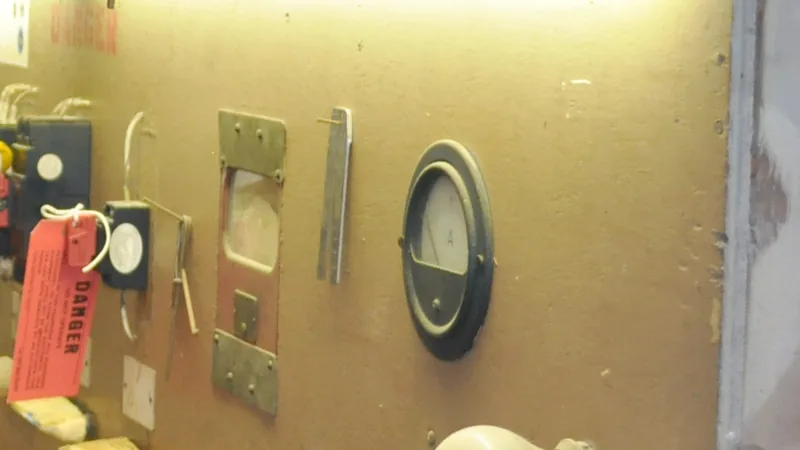
A lockout tag keeps equipment from being switched on during service. Work injuries also happen far from building sites; our workplace accidents page covers warehouses, kitchens, stores and work driving.
Usually not
Often, depending on the facts
- Owner or general contractor on a building job
- Labor Law claims for covered construction, demolition and repair work (construction accidents).
- Another company on the site
- A subcontractor, delivery firm or maintenance contractor that is not your employer.
- The maker or seller of a machine or tool
- A design or manufacturing defect, or a missing warning.
- Another driver
- If you were driving or walking for work when a vehicle hit you.
- A property owner or manager
- When you were hurt working on premises your employer does not control.
When there is a recovery
How the compensation lien and a settlement fit together
1. Notice of the lawsuit
Within 30 days of starting a third-party suit, notice goes to the Board's chair, your employer and the carrier (WCL 29(1)).
2. The lien
The carrier generally has a lien for the compensation and medical benefits it paid, after the reasonable costs of the recovery, including attorney's fees, which a court can apportion. Statutory exceptions apply: for example, there is no lien on certain motor-vehicle recoveries for benefits paid in place of no-fault benefits (WCL 29(1-a)).
3. Future benefits
After a recovery the carrier generally pays only any shortfall, so later benefits can be credited against your net recovery (WCL 29(4)).
4. Consent to settle
A settlement below the compensation the law provides needs the carrier's written approval or a court order (WCL 29(5)). We seek one or the other before any settlement.
Between defendants. A company you sue can bring your employer into the case for common-law contribution or indemnity only if you suffered a “grave injury” as the statute lists it; a written indemnity agreement the employer signed before the accident is a separate route (WCL 11). Neither lets you sue your employer or reduces your claim against the third party.
Deadlines
The clocks that matter
- Tell your employer
- In writing within 30 days (WCL 18).
- Compensation claim
- Within two years of the accident; illness from exposure follows a separate rule (WCL 28).
- Lawsuit against a private company
- Generally three years (CPLR 214).
- A city, county, town, village or school district
- Usually a notice of claim within 90 days and suit within one year and 90 days (GML 50-e, 50-i). Other public bodies differ; see the construction near-me page.
- A death
- Generally two years from the death (EPTL 5-4.1); public bodies add notice rules.
Published results
Work injury results
Quoted exactly as recorded. These are firm-wide results from work injuries; none names a county or the law the claim was brought under, and they are not predictions. Over 40 years, the firm has recovered more than $100 million for clients.
Prior results do not guarantee a similar outcome. Every case depends on its own facts.
See the full verdicts and settlements archive$8,000,000
$8 Million Dollar Settlement — 2nd Department
Plaintiff sustained a series of fractures and other injuries to the right shin, heel and foot, requiring nailing of the right tibia with two proximal and two distal locking bolts, ultimately resulting in below-the-knee amputation.
$1,157,000
$1,157,000 Award
Plaintiff injured at worksite sustaining traumatic tear of the left biceps tendon with tendon retraction which required surgery.
$750,000
$750,000 Settlement
Plaintiff injured when telephone pole struck him causing a traumatic brain injury and shoulder injury requiring surgery.
Hurt at work and unsure who else is responsible?
Tell us where it happened and who was working there. We will tell you whether a claim beyond compensation exists and which deadline runs first.
Questions
Workplace Accident FAQs
Workers' compensation is no-fault insurance your employer carries: for eligible employees with a work-related injury, it pays medical care and part of lost wages, whoever was careless, and the Workers' Compensation Board decides disputes. A third-party lawsuit is a court claim against someone other than your employer, such as a contractor, property owner or machine maker, that is legally responsible for the injury. It must prove that responsibility, but can recover damages compensation does not pay, including pain and suffering.
They apply mainly to building work. Labor Law 240(1) requires owners and contractors to provide proper protection, such as scaffolds and ladders, against gravity hazards during construction, demolition, repair, painting or cleaning of a building or structure. Section 241(6) requires compliance with specific State Industrial Code rules. Section 200 is the general duty to keep workplaces reasonably safe. Each has limits and exceptions; our construction accidents page explains which one fits.
Anyone other than your employer and co-workers whose negligence or Labor Law violation caused the injury: a property owner or general contractor on a building job, another subcontractor, the maker or seller of a defective machine or tool, a driver who hit you while you worked, or the owner of premises your employer does not control. Your employer can be sued directly only in narrow cases, such as when it failed to carry compensation insurance.
Falls from ladders, scaffolds and roofs; being struck by falling objects; machinery and conveyor injuries; vehicle crashes while driving for work; slips and trips; electrical injuries; and exposure to dust or chemicals. The type matters because it points to who else may be responsible and which law applies.
We do not publish ranges, because the answer depends on facts we have not seen. Workers' compensation pays medical care and partial wage benefits; for accidents from July 1, 2026 the weekly maximum is $1,281.50. A third-party lawsuit can add pain and suffering and lost earnings above the benefits, if responsibility is proved. The carrier usually has a lien on part of that recovery, subject to statutory exceptions. Our published results show past outcomes, not predictions.
Photos of the scene and any equipment, the incident report, names of witnesses, the names of the companies on site, your medical records from the first visit on, and pay records. For a machine, keep it unrepaired if you can and note the model and serial number. Evidence disappears as work moves on, so we ask for it early in writing.
Against a private company, generally three years from the accident. If a city, county, town, village or school district may be responsible, a notice of claim is usually due within 90 days and suit within one year and 90 days; some public authorities and the State have their own rules. The compensation side has its own clocks: written notice to your employer within 30 days and a claim within two years.
Get medical care and tell the provider it happened at work. Give your employer written notice within 30 days and keep a copy. Photograph the scene and write down witnesses and the companies working there. Do not give a recorded statement to another company’s insurer or sign anything before we review it. Then call us, especially if a public body may be involved, because a notice can be due within 90 days.
No. It is unlawful for an employer to fire or discriminate against you because you claimed or tried to claim workers' compensation, asked for a claim form or testified. A complaint goes to the Workers' Compensation Board within two years, and the Board can order reinstatement and lost pay (Workers' Compensation Law 120).
It can help as evidence of what went wrong, but an OSHA citation does not by itself prove a lawsuit, and you generally still cannot sue your own employer. Covered employers must report certain deaths, in-patient hospitalizations, amputations and losses of an eye to OSHA, with exceptions, so a report may exist. A Labor Law 241(6) claim rests on the State Industrial Code, not OSHA rules.
Find the right page
Work injury guides by hazard and by place
By hazard
Seriously injured at work? Start with who else was there
Call or send a message with the date, the place and the companies on site. We will explain the lawsuit, how it fits with your compensation claim and the first deadline. Free consultation; no fee unless there is a recovery.
What to bring
- Incident report or your written notice
- Names of companies and witnesses
- Medical records and bills
- Compensation papers you have received