

Work and construction injuries · Staten Island
Staten Island Construction Accident & Work Injury Lawyers
Bridges, the waterfront, City projects and house jobs each bring their own rules on Staten Island, and an employer across the Arthur Kill can raise a New Jersey question.
Over 40 years of experience. Free consultation; no fee unless there is a recovery.
Start here
Bridges, ferries and the New Jersey line
The three bridges to New Jersey are Port Authority facilities, and a claim against the Port Authority needs a notice at least 60 days before suit, with suit within one year. Find the row that fits your job.
These rows are for injury claims against the public body itself. A contractor working on a public job is a separate defendant, sued like a private party. Death claims, and the injured person's own claim continued after death (a survival claim), follow separate rules for each body.
Railroad, ship and harbor workers. If you work for a railroad such as the LIRR, a federal law, FELA, lets railroad employees sue the railroad for injuries caused in whole or in part by its negligence (45 U.S.C. 51), with a three-year limit (45 U.S.C. 56); the New York rules and time limits in this table are not the measure for that claim. Seamen (46 U.S.C. 30104) and some harbor and waterfront workers (33 U.S.C. 903) are also covered by federal law. We check which law applies.
Commuting to a Manhattan job? See Manhattan work accidents; the Brooklyn office also covers Brooklyn construction accidents.
The Labor Law in brief
When an owner or contractor is responsible
- Labor Law 240(1)
- Falls from height and falling objects during erection, demolition, repair, alteration, painting, cleaning or pointing of a building or structure. A violation must cause the injury; with no violation and the worker's own conduct the sole proximate cause, there is no liability (Blake). Owners of one- and two-family homes who contract for but do not direct or control the work may be exempt (text); the exemption turns on the property's use and the work's purpose, not only its structure (Bartoo).
- Labor Law 241(6)
- Construction, excavation and demolition. The claim needs a specific State Industrial Code rule that was violated and caused the injury, not a general safety standard (Ross).
- Labor Law 200
- The general duty of care. For how the work was done, it reaches whoever had authority to control those methods; for a dangerous site condition, an owner or contractor that created it or had actual or constructive notice of it (text).
The full explanation is on our construction accidents page; ladder and scaffold falls on scaffolding injuries.
Compensation and the lawsuit
How the two claims fit together
- Your employer
- Compensation is generally your only remedy against your own employer and a co-worker (WCL 11, WCL 29(6)). The exception: an employer that failed to carry compensation coverage can be sued, so we check.
- Everyone else
- You can collect compensation and also sue a party that is not your employer if it is legally responsible: through negligence, a Labor Law violation or a defective product. Notice of the lawsuit goes to the carrier within 30 days.
- The lien
- The compensation carrier usually has a lien on part of the recovery, after the costs of getting it. Statutory exceptions apply, for example no lien on certain motor-vehicle recoveries for benefits paid in place of no-fault benefits (WCL 29(1-a)). Future benefits can generally be credited against your net recovery.
- Settling
- A settlement for less than the compensation provided needs the carrier's written consent or a court order (WCL 29(5)). We seek one or the other before any settlement.
- Grave injury and indemnity
- A company you sue can seek common-law contribution or indemnity from your employer only if you suffered a grave injury. Separately, it may enforce a written indemnity agreement made before the accident in which your employer expressly agreed to indemnify it. Both are claims between the companies. Neither lets you sue your employer.
Our work is the injury lawsuit against people and companies other than your employer, on a contingency fee: no fee unless there is a recovery. At the consultation we explain how it fits with your compensation claim, where representation is optional and fees are set by the Board (WCB).
More on the two tracks: our work accidents guide. Not a work injury? See Staten Island personal injury.
After the injury
Care, notice and where the case is heard
- Care first. Tell every doctor the injury happened at work.
- Written notice. To your employer within 30 days (WCL 18).
- The owner. Homeowner, developer, the City or the Port Authority.
- Your employer's state. Where it is based and where you were hired.
Where the case is heard. Richmond County's Supreme Court is at 26 Central Avenue, Staten Island. A lawsuit is generally filed in a county where one of the parties lived when it started, or where a substantial part of the events happened (CPLR 503), so it may be heard in another county. We confirm it at the start.

Pictured: the historic Garner mansion on the Richmond University Medical Center campus, under renovation; it is not a treatment building.
- Staten Island University Hospital NorthLevel I
- Richmond University Medical CenterLevel I
Adult trauma designations from the New York State Department of Health. Listed for orientation, not as a recommendation or ranking; in an emergency, call 911.
Published results
Construction and work injury results
Quoted exactly as recorded. These are firm-wide results from work injuries; none names a county or the law the claim was brought under, and they are not predictions. Over 40 years, the firm has recovered more than $100 million for clients.
Prior results do not guarantee a similar outcome. Every case depends on its own facts.
See the full verdicts and settlements archive$8,000,000
$8 Million Dollar Settlement — 2nd Department
Plaintiff sustained a series of fractures and other injuries to the right shin, heel and foot, requiring nailing of the right tibia with two proximal and two distal locking bolts, ultimately resulting in below-the-knee amputation.
$1,157,000
$1,157,000 Award
Plaintiff injured at worksite sustaining traumatic tear of the left biceps tendon with tendon retraction which required surgery.
$750,000
$750,000 Settlement
Plaintiff injured when telephone pole struck him causing a traumatic brain injury and shoulder injury requiring surgery.
Hurt on bridge or waterfront work?
Call us early. Port Authority and City claims each have their own first step.
Questions
Frequently Asked Questions About Staten Island Work Accidents
If you are an eligible employee, workers' compensation covers medical care and part of your lost wages, whoever was at fault, and you generally cannot sue your own employer. You may also sue an owner, contractor or other company that is legally responsible. If your employer or the job is in New Jersey, which state's rules apply needs checking early. The compensation carrier usually has a lien on part of any recovery, subject to statutory exceptions.
We do not rank job types or neighborhoods; we have no reliable public data for that here. Construction injuries typically involve falls from ladders, roofs and scaffolds, falling material, trenches and machinery. On Staten Island, house jobs, bridge and waterfront work, and City projects each bring different owners, and for public owners, different notice deadlines.
Yes, but usually not your employer. You can keep collecting compensation and sue an owner, general contractor, another subcontractor, an equipment maker or a driver who is legally responsible. Notice of the lawsuit goes to the carrier. The carrier usually has a lien on part of the recovery, subject to statutory exceptions, and a settlement for less than the compensation provided needs its written consent or a court order.
Labor Law 240(1) requires owners, contractors and their agents to provide proper protection against falls and falling objects during building, demolition, repair, alteration, painting, cleaning or pointing. If a missing or inadequate device caused the injury, your own carelessness is not a defense; with no violation and your own conduct the sole proximate cause, there is no claim. Owners of one- and two-family homes who contract for but do not direct or control the work may be exempt, depending on the property’s use.
We do not publish ranges. Value depends on the injury and its permanence, lost earnings, medical needs, the proof of responsibility, any compensation lien and the insurance available. A successful lawsuit can recover pain and suffering and lost earnings that compensation does not pay. The firm-wide results on this page are shown exactly as recorded; none names a county, and they are not predictions.
Get medical care and tell the doctor it happened at work. Give your employer written notice within 30 days. Note who owns the job: a homeowner, a developer, the City or the Port Authority. Photograph the hazard and any permit or contractor sign. Do not give a recorded statement to another company’s insurer before talking to us. A Port Authority claim needs a notice at least 60 days before suit.
Yes. The Workers' Compensation Board says benefits are available regardless of citizenship or immigration status. In Labor Law cases, the Court of Appeals held that federal immigration law does not bar a lost-wage claim, absent proof that the worker gave false work-authorization documents to get the job (Balbuena, 2006). Tell us your situation at the start so we can prepare for questions that may come up.
Injury claims against a private owner or contractor: generally three years. The Port Authority (the three bridges to New Jersey): a notice of claim at least 60 days before suit; suit within one year. The City: a notice of claim, usually within 90 days where required, and suit within one year and 90 days. The State: within 90 days, a claim filed with the Court of Claims and served on the Attorney General, or a notice of intention served on the Attorney General. Death claims follow separate rules.
Compensation comes from your employer's carrier without proof of fault and pays medical care and, for eligible workers, partial wage benefits based on wages and disability; for accidents from July 1, 2026 to June 30, 2027, weekly wage benefits are capped at $1,281.50. A Labor Law lawsuit is against an owner or contractor, not your employer, and can recover pain and suffering and lost earnings if a violation caused the injury. You can have both; the carrier usually has a lien on part of the lawsuit recovery.
No public dataset we rely on ranks Staten Island neighborhoods by work accidents, so we do not. For a claim, the type of job matters more: house construction and renovation, the North Shore waterfront and St. George projects, bridge work and City projects each involve different owners and deadlines. Tell us the address and we will identify the owner.
In an emergency, call 911. The State designates two adult Level I trauma centers on Staten Island: Staten Island University Hospital North and Richmond University Medical Center. Wherever you are treated, say the injury happened at work so the record shows it, and keep every report and bill. This is orientation, not a recommendation.
Offices
Where to meet us
Our offices are listed below, including the Brooklyn office on Kings Highway; the main office is in Uniondale.
- Uniondale (main office)
Convenient for Nassau and Suffolk counties
423 RXR Plaza, East Tower, Uniondale, NY 11556(516) 227-2662
- Brooklyn
Convenient for Brooklyn and Staten Island
3857 Kings Highway, #1f, Brooklyn, NY 11234(718) 710-4880
- Corona (Queens)
Convenient for Queens and the Bronx
100-17 Northern Boulevard, Corona, NY 11368
- Teaneck (New Jersey)
Convenient for New Jersey
696 Palisade Avenue, Teaneck, NJ 07666
Injured at work on Staten Island? Start with who owns the job
Tell us the address, the work you were doing and who employed you. We will identify the claim, the parties and the first deadline. Free consultation; no fee unless there is a recovery.
What to bring
- Site address and owner, if known
- Your employer and where it is based
- Photos of the device or hazard
- Medical records and your written notice
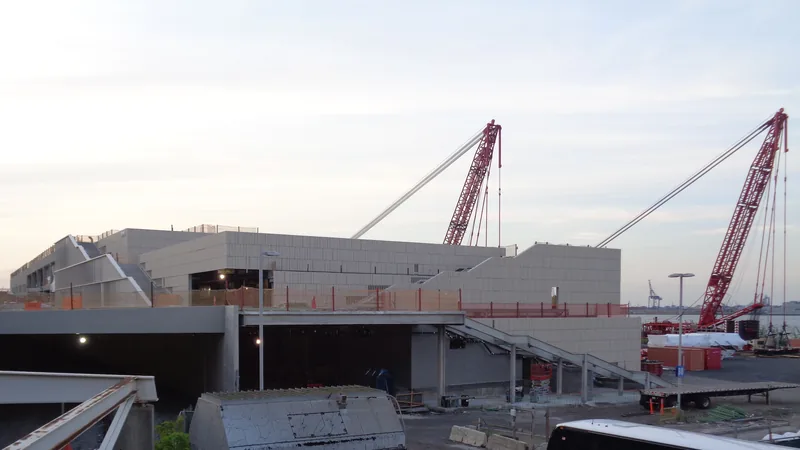
Photo credits: Parking garage under construction, St. George by Tdorante10, CC BY-SA 4.0, cropped and resized; Garner mansion, Richmond University Medical Center by Jim.henderson, CC BY-SA 3.0, cropped and resized.