

Scaffold falls, collapses and falling objects
Scaffolding Accident Lawyers for Long Island, Queens and NYC Workers
A worker hurt on a scaffold usually has a workers' compensation claim and, when the scaffold did not give proper protection, a separate Labor Law lawsuit against the owner and contractors.
The lawsuit turns on what the scaffold looked like that day, so the evidence has to be secured before it is changed or taken down.
Start here
Two claims after a scaffold fall
Workers' compensation and a Labor Law lawsuit run side by side. They are paid by different parties and require different proof.
- Who pays
- Workers' comp: Your employer's workers' compensation coverage
- Labor Law lawsuit: Owners, contractors and their agents named in Labor Law 240 and 241
- What you prove
- Workers' comp: That the injury happened in the course of your work
- Labor Law lawsuit: A statutory violation (for example, a scaffold that did not give proper protection) that caused the injury
- What it can cover
- Workers' comp: Benefits set by the workers' compensation system
- Labor Law lawsuit: Damages in a lawsuit, including pain and suffering and lost earnings
- Your own fault
- Workers' comp: Not the focus of the benefits claim
- Labor Law lawsuit: Under 240(1), your carelessness does not defeat the claim when a violation caused the fall
The Scaffold Law
What Labor Law 240(1) requires, and where it stops
Section 240(1) requires contractors, owners and their agents to furnish scaffolding and other devices "so constructed, placed and operated as to give proper protection" to workers erecting, demolishing, repairing, altering, painting, cleaning or pointing a building or structure.
Section 240(2) adds that scaffolding more than twenty feet from the ground or floor must have a safety rail at least thirty-four inches high along its open length and ends, with limited exceptions.
Your carelessness is not a defense
When a violation proximately caused the fall, "contributory negligence will not exonerate" the defendant (Blake, 2003).
But a violation is required
There is no 240(1) liability when there was no violation and the worker's own actions were the "sole proximate cause" of the accident. The statute does not make an owner an insurer once it furnished a safe workplace.
Some owners are excepted
Owners of one- and two-family dwellings who contract for but do not direct or control the work, and design professionals who do not direct or control it, are outside 240(1).
Section 241(6) separately requires construction, excavation and demolition areas to provide "reasonable and adequate protection and safety" and requires owners and contractors to follow the commissioner's rules. It is often pleaded alongside 240(1).
First days
Scaffold evidence to secure early
Scaffolds are adjusted, repaired and dismantled as work continues. What it looked like at the moment of the fall usually decides the case.
- The platform: planking, gaps, guardrails, midrails, toeboards, tie-ins to the building and base plates.
- Load and assembly: OSHA requires each scaffold to support its own weight and at least four times its maximum intended load (29 CFR 1926.451).
- Fall protection: whether harnesses, lanyards and anchor points were provided and usable.
- Paperwork: contracts, permits, site safety plans, inspection tags and daily logs that show who owned, managed and controlled the work.
- People: co-workers and foremen who saw the set-up, and the accident report filed afterward.
Construction and worksite results
Results for injured workers
These are the firm's published construction and worksite results. None of the published descriptions identifies a scaffold accident or the county where the injury happened.
Prior results do not guarantee a similar outcome. Every case depends on its own facts.
See the full verdicts and settlements archive$8,000,000
$8 Million Dollar Settlement — 2nd Department
Plaintiff sustained a series of fractures and other injuries to the right shin, heel and foot, requiring nailing of the right tibia with two proximal and two distal locking bolts, ultimately resulting in below-the-knee amputation.
$1,157,000
$1,157,000 Award
Plaintiff injured at worksite sustaining traumatic tear of the left biceps tendon with tendon retraction which required surgery.
$750,000
$750,000 Settlement
Plaintiff injured when telephone pole struck him causing a traumatic brain injury and shoulder injury requiring surgery.
Long Island, Queens and the boroughs
Scaffold injury claims near you
Our Uniondale, Corona and Brooklyn offices serve injured workers across Long Island and New York City. Contact us to discuss a consultation. Many scaffold cases involve facade, roofing, masonry and painting work on apartment buildings, storefronts and commercial sites.
Related
Other construction injuries
- Construction accidents covers ladders, trenches and site hazards beyond scaffolds.
- Crane accidents and building collapses raise related Labor Law issues.
- Work accidents explains workers' compensation alongside lawsuits.
- If a worker died, see wrongful death.
Questions
Scaffolding accident questions
Often there are two separate claims. Workers' compensation benefits come through your employer's coverage. Separately, New York Labor Law 240(1) lets an injured worker sue the owners, contractors and their agents the statute names when the scaffold or other safety device did not give proper protection and that failure caused the injury. The lawsuit seeks damages, including pain and suffering.
Contractors and owners and their agents doing the erection, demolition, repairing, altering, painting, cleaning or pointing of a building or structure must furnish or erect scaffolding, hoists, stays, ladders, slings, hangers, blocks, pulleys, braces, irons, ropes and other devices so constructed, placed and operated as to give proper protection to the worker. Owners of one- and two-family dwellings who contract for but do not direct or control the work are excepted.
Not if the statute was violated and the violation was a proximate cause of the fall. In Blake v Neighborhood Housing Services (2003), the Court of Appeals said contributory negligence will not exonerate a defendant who violated the statute and proximately caused the injury. But Blake also held there is no 240(1) liability when there was no violation and the worker's own actions were the sole proximate cause, because the statute does not make an owner an insurer after it furnished a safe workplace.
Section 241(6) requires that areas where construction, excavation or demolition work is performed be constructed, shored, equipped, guarded, arranged, operated and conducted to provide reasonable and adequate protection and safety, and that owners and contractors comply with the rules the commissioner makes to carry this out. It is often pleaded alongside 240(1), and which rule applies to the facts of your accident matters.
A personal injury action is generally subject to a three-year limitations period (CPLR 214). If a city, county, town, village or similar public body owns the property, a notice of claim is generally due within 90 days (General Municipal Law 50-e) and the action within one year and 90 days (General Municipal Law 50-i). Report the injury to your employer right away and ask how to file for workers’ compensation.
The scaffold itself before it is moved or changed: planks, guardrails, tie-ins, base plates, access ladders and any harness anchor points. Federal OSHA rules require scaffolds to support their own weight and at least four times the maximum intended load. Photographs, inspection tags, the site safety plan, daily logs, the contracts that show who owned, managed and controlled the work, and witness names often decide who is responsible.
Yes. Our offices in Uniondale (Nassau County), Corona (Queens) and Brooklyn serve injured workers across Long Island and the five boroughs, including work on scaffolds, sidewalk sheds, suspended platforms and ladders.
Talk to a scaffolding accident lawyer
Tell us where the job was and who was on site. We will look at who owned and controlled the work, which Labor Law claims fit, and what to preserve now. The consultation is free.
What to bring
- Site address and the name of your employer
- Photos or video of the scaffold
- Your workers' compensation claim number, if any
- Names of co-workers and the foreman
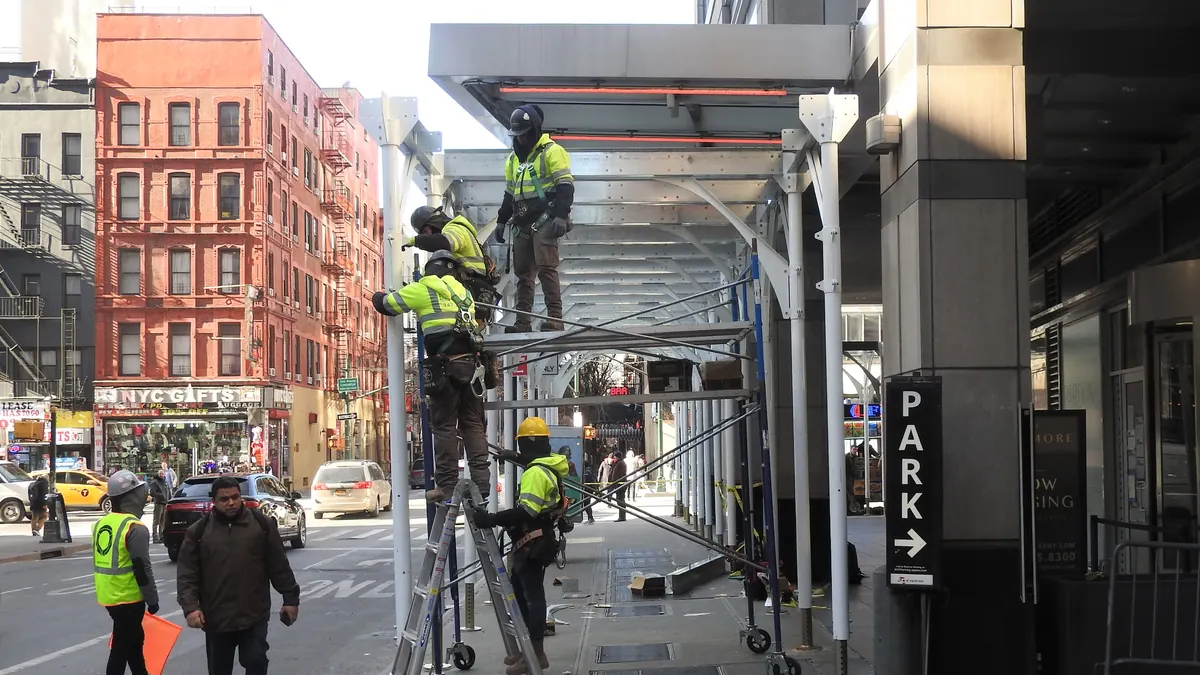
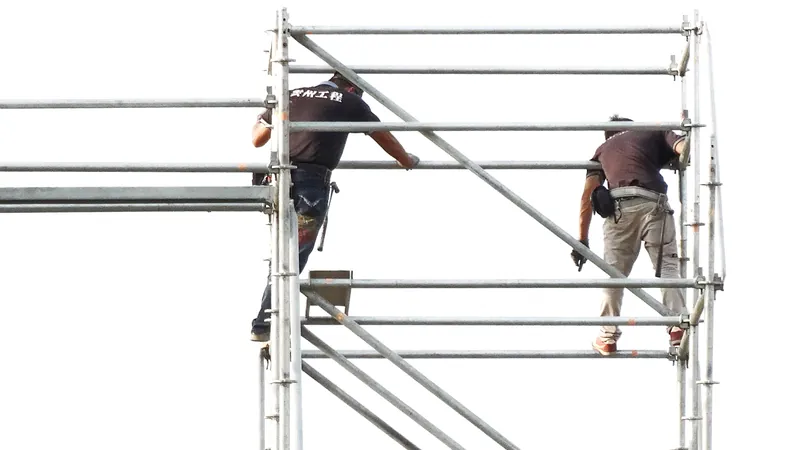
Photo credits: West 47th Street sidewalk shed work by Jim.henderson, CC BY-SA 4.0, cropped and resized; Workers on a metal pole scaffold by Mk2010, CC BY-SA 4.0, cropped and resized.