

Crane collapses, dropped loads and power-line contact
New York Crane Accident and Crane Collapse Attorneys
A crane injury claim depends on who was hurt. Workers may have Labor Law claims against owners and contractors; bystanders bring negligence claims. Neither is automatic.
We represent workers and passers-by on Long Island and across New York City.
Start here
Worker or bystander? Two different claims
Construction workers
- Labor Law 240(1) requires owners and contractors to provide hoists, slings, blocks, ropes and other devices that give proper protection during covered work. The question is whether the injury came from a failure to protect against a risk arising from a physically significant elevation differential.
- Where the statute applies and its violation is a proximate cause, the worker's own negligence is not a defense; where there is no violation and the worker's conduct is the sole proximate cause, there is no 240(1) liability (Blake, 2003).
- Labor Law 241(6) requires reasonable and adequate protection where construction, excavation or demolition work is performed.
- Owners of one- and two-family dwellings who do not direct or control the work are excepted. Workers' compensation generally covers the employer separately.
Pedestrians, neighbors and drivers
- A bystander's claim is generally ordinary negligence: proof that the contractor, crane owner, operator or property owner failed to use reasonable care.
- Evidence usually comes from the same lift records, plus site-safety and city inspection records.
- If a public entity owned the project or property, a notice of claim is generally due within 90 days (General Municipal Law 50-e).
- Most injury lawsuits must be filed within three years (CPLR 214); wrongful death generally within two years of death (EPTL 5-4.1).
The falling-object rule
Not every crane injury is automatic liability
“Falling object” liability is not limited to objects actively being hoisted or secured. Whether the object required securing for the work, and whether missing or inadequate protection caused the injury, matters.
Quattrocchi v F.J. Sciame Constr. Co., 11 NY3d 757 (2008). That is why the rigging and lift records below are gathered first.
Proof
The lift records that decide crane cases
Crane collapses and dropped loads usually trace back to planning, rigging or the decision to lift in the conditions that day. Federal rules cover operator certification and power-line safety.
- 1
Lift plan and load charts
Whether the lift was within the crane's rated capacity for that radius and configuration.
- 2
Rigging inspection records
Slings, shackles and hooks that were worn, overloaded or wrongly chosen.
- 3
Operator certification
Federal rules require operators to be trained, certified or licensed, and evaluated.
- 4
Power-line planning
Whether anyone determined if the equipment could come within 20 feet of a line.
- 5
Site-safety logs and weather
Wind conditions, stop-work decisions, exclusion zones and who directed the lift.
Construction results
Results for injured workers
These are the firm's published construction and work accident results. None of the published descriptions identifies a crane accident; they are shown as examples of worksite injury cases only.
Prior results do not guarantee a similar outcome. Every case depends on its own facts.
See the full verdicts and settlements archive$8,000,000
$8 Million Dollar Settlement — 2nd Department
Plaintiff sustained a series of fractures and other injuries to the right shin, heel and foot, requiring nailing of the right tibia with two proximal and two distal locking bolts, ultimately resulting in below-the-knee amputation.
$750,000
$750,000 Settlement
Plaintiff injured when telephone pole struck him causing a traumatic brain injury and shoulder injury requiring surgery.
$1,157,000
$1,157,000 Award
Plaintiff injured at worksite sustaining traumatic tear of the left biceps tendon with tendon retraction which required surgery.
Related
Related construction injuries
- Construction accidents and the Labor Law claims behind them.
- Scaffolding injuries, the other core Labor Law 240(1) case.
- Building collapse injuries to workers and neighbors.
- Forklift accidents on construction and warehouse sites.
- Work accidents of every kind.
- Wrongful death after a fatal crane accident.
- Local pages: Long Island, Manhattan and Queens work accidents.
Questions
Crane accident questions
No. Labor Law 240(1) applies to covered work such as erecting, demolishing, repairing or altering a building or structure, and to elevation-related risks. For a falling object, more than the fact that something fell is required: the injury must be tied to a failure of the protection the statute requires. Quattrocchi v F.J. Sciame (2008) confirms that the object need not have been actively being hoisted or secured when it fell. When the statute does apply and its violation is a proximate cause of the injury, the worker's own carelessness is not a defense.
Workers' compensation generally covers your employer. A separate injury claim may be possible against others, such as the property owner, the general contractor, the crane owner or a subcontractor, under Labor Law 240(1), Labor Law 241(6) or ordinary negligence, depending on what work was being done and who controlled it.
A bystander generally brings a negligence claim against the contractors, crane owner and operator, and property owner whose conduct caused the collapse or dropped load, proving that they failed to use reasonable care. If a city or other public entity owned the project or property, a notice of claim is generally due within 90 days (General Municipal Law 50-e).
Labor Law 241(6) requires that areas where construction, excavation or demolition work is performed be constructed, shored, equipped, guarded, arranged, operated and conducted to provide reasonable and adequate protection and safety to the persons employed there or lawfully frequenting those places, and it authorizes the commissioner to make rules. Owners of one- and two-family dwellings who contract for but do not direct or control the work are excepted.
The lift plan, load charts, rigging inspection records, the operator's training and certification (federal rules require operators to be trained, certified or licensed, and evaluated under 29 CFR 1926.1427), power-line clearance planning (29 CFR 1926.1408), site-safety logs, weather data and photographs or video of the crane and load.
Most personal injury lawsuits must be started within three years (CPLR 214). Claims involving a public owner or entity generally need a notice of claim within 90 days (General Municipal Law 50-e). A wrongful death action must generally be commenced within two years of death (EPTL 5-4.1).
Get medical care and report the injury to your employer in writing. Photograph the crane, the load, the rigging and the area if you can do so safely, and write down the names of witnesses, the general contractor and the crane company. Do not give recorded statements to insurers before speaking with a lawyer.
We represent injured workers and bystanders on Long Island and throughout the five boroughs of New York City, from offices in Uniondale, Brooklyn and Corona, and in New Jersey.
Talk to a New York crane accident lawyer
Tell us where the crane was, what it was lifting and whether you were working or passing by. We will explain which claim fits, which records to demand and the deadline that applies. The consultation is free.
What to bring
- Site address and general contractor name
- Your employer and union, if any
- Photos or video of the crane and load
- Medical records so far
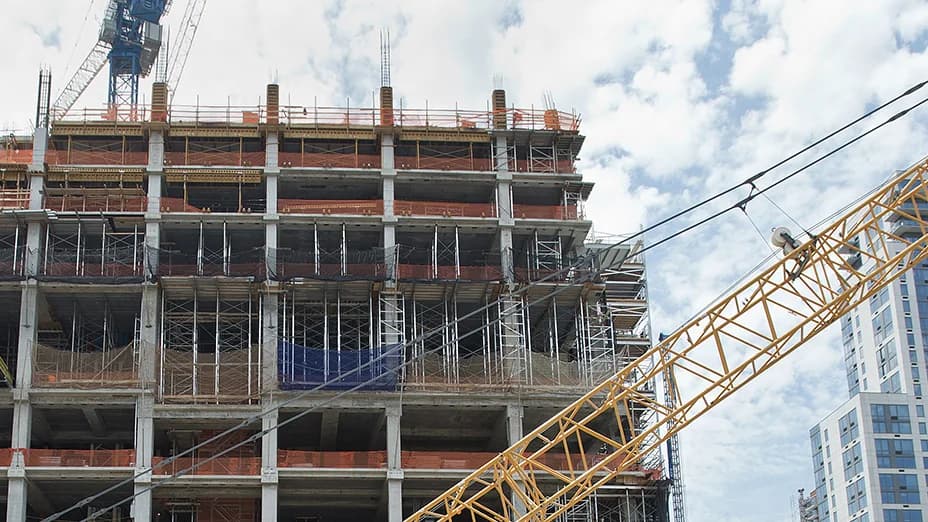
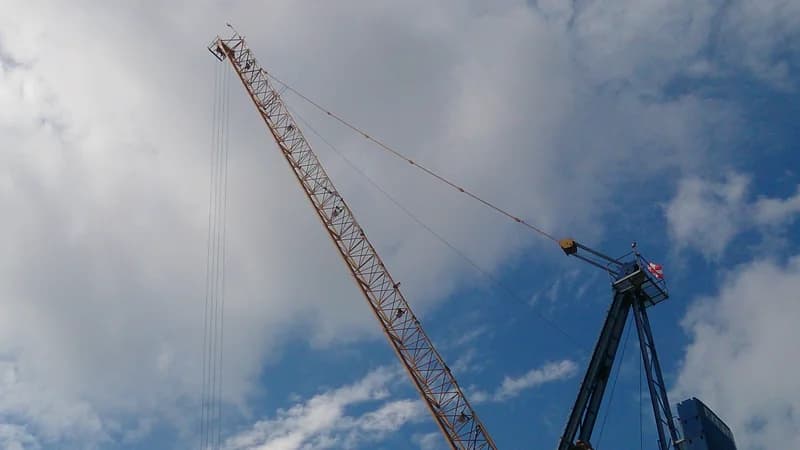
Photo credits: Hudson Yards crane by Metropolitan Transportation Authority of the State of New York, CC BY 2.0, cropped and resized; Tower crane by ProjectManhattan, CC BY-SA 3.0, cropped and resized.