

Trucking Accidents (New Jersey)
New Jersey Truck Accident Lawyer
Federal rules set minimum periods for trucking companies to keep driver logs, maintenance files and crash records. They are minimums, not permission to destroy evidence once a claim is expected; a prompt preservation demand puts the carrier on notice.
Over 40 years of experience. Free consultation; no fee unless there is a recovery.
Carrier records and their clocks
- Driver’s hours-of-service logs
- Carriers must keep records of duty status and supporting documents for at least 6 months.
- 49 C.F.R. 395.8(k)
- Inspection, repair and maintenance records
- Kept for 1 year, and for 6 months after the truck leaves the carrier’s control.
- 49 C.F.R. 396.3(c)
- Post-crash alcohol and drug tests
- For drivers covered by the federal testing rules: required after a fatal crash, or after a crash with a citation and an injury treated away from the scene or a tow-away; alcohol testing is tied to an 8-hour window and drug testing to 32 hours.
- 49 C.F.R. 382.303
- Hours-of-service limits
- Property-carrying drivers: 11 hours of driving within a 14-hour window after 10 hours off, with a 30-minute break after 8 hours of driving (short-haul exceptions).
- 49 C.F.R. 395.3
Each rule applies only to the carriers and drivers within its scope (for example, the testing rules cover drivers in the federal testing program, and the hours limits shown are for property-carrying drivers). Coverage, and any New Jersey rules for carriers operating only within the state, are checked case by case. Text current as of the eCFR update of October 7, 2026.
Responsibility
Who may share responsibility besides the driver
- Motor carrier
- Employs or dispatches the driver; responsible for hiring, training, supervision, scheduling and maintenance.
- Driver file, dispatch and log data
- Shipper or loader
- Overweight, unbalanced or unsecured cargo can cause rollovers, jackknifes and spills.
- Bills of lading, load records
- Maintenance or repair shop
- Brake, tire and lighting work done badly or not at all.
- Repair orders, inspection reports
- Manufacturer
- A defective part, such as brakes, tires or couplings, that failed.
- The vehicle and the failed part
- Other motorists
- Cut-ins, sudden stops and lane changes around trucks.
- Video, event data, witnesses
- Public entity
- A dangerous road or work-zone condition, under the Tort Claims Act: 90-day notice and limits on damages.
- Maintenance and work-zone records
Common causes include driver fatigue, inadequate training, poorly maintained trucks, equipment failures, improperly loaded cargo, impaired or distracted driving, and weather and road conditions. Hurt at a jobsite or in a work zone while working? See New Jersey construction accidents.
In a car hit by a truck
Your PIP, your lawsuit option and the carrier's insurance
- PIP. The policy that applies to you, usually your own or a resident relative's, generally pays medical expenses regardless of fault; a health-insurance-primary election changes the order.
- Lawsuit option. The limitation on lawsuit option restricts pain-and-suffering claims only against defendants the statute protects: owners, operators and occupants of an automobile with New Jersey PIP-type coverage. Whether a commercial truck qualifies is checked case by case. See New Jersey auto accidents.
- The carrier's coverage. For-hire interstate carriers of general freight in trucks of 10,001 pounds or more must carry at least $750,000 in public liability coverage, more for some hazardous loads (49 C.F.R. 387.9). That is a federal minimum, not a promise about any policy or claim.
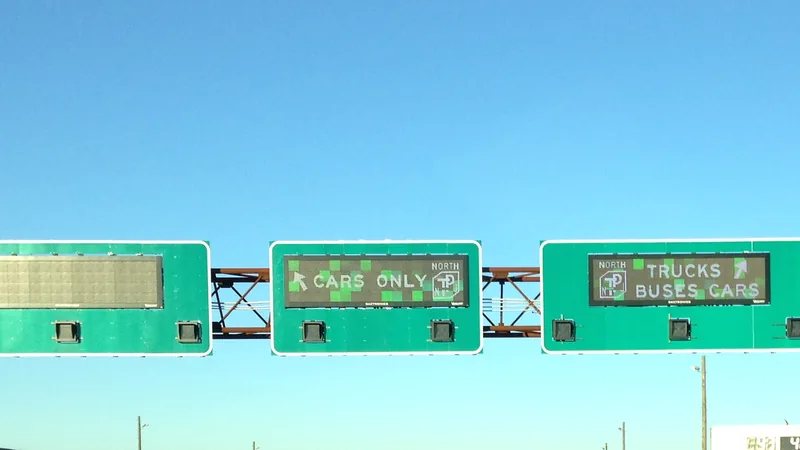
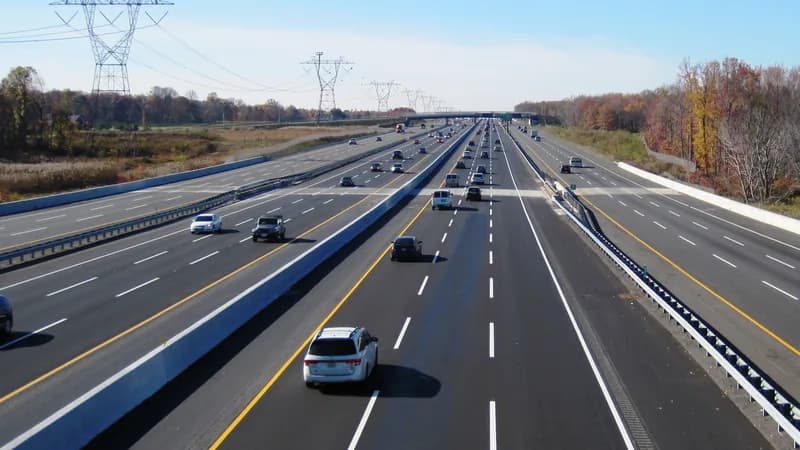
On the Turnpike's widened sections, trucks and buses are directed to the outer roadway. Where the roadways split and merge, drivers change lanes around trucks, which is why video and event data matter.
Commercial Truck Evidence Review
We Preserve the Trucking Records Before the Carrier Controls the Story
Truck crashes call for fast preservation of driver logs, maintenance files, dispatch records, cargo documents, dashcam video and engine control data. We identify every carrier, broker, maintenance company and insurer that may share responsibility.
- Driver and carrier file
- Hours-of-service logs, qualification files and dispatch records show whether safety rules were followed.
- Vehicle and cargo proof
- Maintenance, inspection, loading and electronic data can show how the crash became preventable.
What to do after being in an accident with a commercial truck
Call 911. Get police to the scene and medical care for everyone hurt.
Photograph. The truck, trailer, any USDOT number on the cab, the scene and your injuries.
Collect names. Driver, carrier and witnesses; do not discuss fault or sign carrier paperwork.
Get the report number. And the officer’s name.
Open your PIP claim. With your own auto insurer.
Call us early. So preservation demands reach the carrier while the records still exist.
Hit by a tractor-trailer? Federal retention periods are only minimums. We send preservation demands right away so the carrier is on notice to keep the evidence.
Deadlines
New Jersey filing deadlines after a truck crash
- 2 years
- Most New Jersey personal injury lawsuits must be filed within two years after the claim accrues, usually the date of injury.
- N.J.S.A. 2A:14-2(a)
- 90 days
- Generally, notice is due within 90 days of accrual and suit within two years for a claim against a public entity or employee. A court may permit late notice within one year for extraordinary circumstances and no substantial prejudice. Minors, incapacity and accrual can change these clocks; seek prompt review.
- N.J.S.A. 59:8-8, 59:8-9
- Wrongful death
- Two years from the date of death (the statute has a limited exception for deaths caused by homicide offenses).
- N.J.S.A. 2A:31-3
If a family member died, see New Jersey wrongful death claims. If the crash happened in New York, see our New York truck accident page.
Published results
Truck and auto accident results
These are the firm's published truck and auto accident results, quoted exactly as recorded; they are firmwide results. Only the first record is identified as a New Jersey case, as its text says; the other results are firmwide and should be read as each record describes them. They are not a prediction for any other case.
Prior results do not guarantee a similar outcome. Every case depends on its own facts.
See the full verdicts and settlements archive$750,000
$750,000 New Jersey Truck Accident Settlement
Michael Licatesi and our New Jersey trial team secured a $750,000 settlement for our client who was seriously injured in a truck accident.
$350,000
$350,000 Federal Case Result — Truck Rear-End Collision
A 40-year-old woman was rear-ended by a truck while properly restrained. She suffered serious injuries, including an annular tear in her neck, back injuries requiring ablation and multiple injections, and injuries to her right shoulder, knee requiring surgery, hand, and elbow.
$499,000
$499,000 Federal Truck Accident Settlement
Our client was involved in a truck accident that resulted in federal litigation. Despite the complexity of the case, we secured a $499,000 settlement for injuries sustained to multiple parts of the body.
$300,000
$300,000 Recovery — Brooklyn 18-Wheeler Rear-End Collision
Our client, a NYC probation officer, was stopped at a red light in Brooklyn when an 18-wheeler rear-ended his vehicle. He suffered multiple injuries. We fought to get him the compensation he deserved. We are proud to secure a $300,000 recovery for our client.
$380,000
$380,000 Recovery — Brooklyn Truck Rear-End Collision
Our client, a NYC probation officer, was a passenger in a work vehicle rear-ended by a truck at a red light in Brooklyn. She suffered multiple injuries including surgery. We're proud to have secured a $380,000 recovery for her.
$400,000
$400,000 Settlement
Settlement involving 68 year old male who was rear ended by a truck while driving for UBER requiring a lumbar fusion with a history of prior injury to his lumbar spine.
Questions
Frequently Asked Questions
New Jersey applies its own rules: a two-year filing deadline for most injury claims; recovery only if your fault is not greater than the defendants’ combined; PIP from the policy that applies to you; and, where the lawsuit limitation applies to both the injured person and the defendant’s vehicle, pain and suffering only for listed serious injuries. Federal safety rules apply to covered carriers in both states. Which state’s law governs is checked case by case.
Generally two years after an injury claim accrues and two years from the date of death for a wrongful death claim. If a public entity may share responsibility, for example for a road or work-zone condition, a written notice of claim is generally due within 90 days of accrual. Federal record-retention periods are only minimums, and a carrier on notice of a claim may have to keep evidence longer, so a preservation demand should go out early.
It is the limitation on lawsuit option on New Jersey auto policies. Whether it applies depends on the injured person’s policy and on whether the defendant’s vehicle is one the statute protects; a commercial truck may not be. Where it applies, pain and suffering is recoverable only for death, dismemberment, significant disfigurement or scarring, a displaced fracture, loss of a fetus, or a permanent injury, with a physician certification. Economic losses beyond PIP can be claimed either way.
Depending on the facts: the driver; the motor carrier that employed or dispatched the driver, including for hiring, training, supervision or maintenance; the company that loaded the cargo; a maintenance or repair shop; the maker of a defective part; other motorists; and a public entity for a dangerous road condition, subject to the Tort Claims Act. Each defendant’s share of fault is decided by the jury.
PIP on the policy that applies to you generally pays medical bills first. From the responsible parties you can claim medical expenses and lost earnings PIP did not cover, loss of earning capacity, and pain and suffering, subject to any lawsuit limitation that applies. If someone died, the family may bring wrongful death and survival claims. Punitive damages require clear and convincing proof of actual malice or wanton and willful disregard; even gross negligence is not enough.
If you were in a car, PIP on the policy that applies to you, usually your own or a resident relative’s, pays medical expenses regardless of fault: on a standard policy, $250,000 unless a lower amount was elected, with a statutory exception for certain serious injuries. PIP does not pay pain and suffering. The trucking company’s liability insurance answers for the rest. Federal rules set minimum coverage for many interstate carriers, but a minimum is not a measure of any claim.
Major New Jersey freight corridors include the New Jersey Turnpike, whose dual-roadway sections direct trucks and buses to the outer lanes, Interstates 80, 287, 78 and 95, the roads serving the ports at Newark and Elizabeth, and state highways such as Routes 46 and 17. Crashes also happen at warehouse driveways and in work zones. The location matters most for who maintained the road and what video exists.
Truck cases usually involve a carrier with its own investigators, records whose federal retention periods are only minimums, several possible defendants and larger insurance policies. A lawyer sends preservation demands quickly, obtains the driver’s logs and the electronic data, and coordinates the claim with your PIP and any lawsuit limitation. The consultation is free and there is no fee unless there is a recovery.
Call 911 and get medical care. If you can, photograph the truck, its trailer and any USDOT number on the cab, the scene and your injuries, and get witness names. Do not discuss fault with the driver or sign anything from the carrier. Get the police report number, open your PIP claim, and call us so preservation letters reach the carrier early.
It depends on the injury and its permanence, whether your tort option allows a pain-and-suffering claim, medical costs beyond PIP, lost income, any share of fault assigned to you, and the insurance available from every responsible party. We do not quote values before the medical picture and the evidence are known, and past results do not predict another case.
Back to the New Jersey personal injury overview.
New Jersey office: 696 Palisade Avenue, Teaneck, NJ 07666 · 908-667-0077 · directions and hours
Talk to a New Jersey Truck Accident Lawyer
We will identify the carrier and every other party that may be responsible, send preservation demands and coordinate the claim with your PIP. Free consultation; no fee unless there is a recovery.
What to bring
- Photos of the truck, trailer and any USDOT number
- The police report number and witness names
- Your auto insurance declarations page and PIP claim number
- Medical records and proof of missed work
Related
New Jersey crash and fatal-injury guides
Photo credits: New Jersey Turnpike, Robbinsville by Mr. Matté, CC BY-SA 3.0, cropped and resized; Turnpike lane signs by Famartin, CC BY-SA 3.0, cropped and resized.