

Auto Accidents (New Jersey)
New Jersey Auto Accident Attorney
After a New Jersey crash, PIP on the policy that applies to you generally pays medical bills whoever was at fault. Whether you can also sue for pain and suffering depends on that policy's lawsuit option and on the vehicle you are suing.
Over 40 years of experience. Free consultation; no fee unless there is a recovery.
Which insurance answers first
1. PIP that applies to you
Medical bills, regardless of fault, usually from your or a resident relative’s policy; without one, other coverage or the fund may apply.
2. The at-fault driver
Their liability policy answers for losses PIP does not cover and, where the lawsuit limitation allows, pain and suffering.
3. Your UM/UIM
If that driver fled, had no insurance or too little, your own uninsured or underinsured motorist coverage may pay.
The lawsuit option
Can you sue for pain and suffering? Check the option on your policy
Every New Jersey auto policy carries one of two tort options. The choice is made in writing on the coverage selection form; if the named insured never chose, the law treats the policy as carrying the limitation on lawsuit option. Your insurer can confirm which one applies (NJ Department of Banking and Insurance; N.J.S.A. 39:6A-8, 39:6A-8.1).
- Pain and suffering
- Limitation: Only for death, dismemberment, significant disfigurement or scarring, a displaced fracture, loss of a fetus, or a permanent injury.
- No limitation: Can be claimed for any injury caused by the other driver’s negligence.
- Proof
- Limitation: A treating or referred board-certified physician certifies the injury, based on objective clinical evidence, within 60 days after the defendant’s answer.
- No limitation: Ordinary proof of injury and damages.
- Economic loss beyond PIP
- Limitation: Can still be claimed.
- No limitation: Can be claimed.
- Who it covers
- Limitation: The named insured and resident immediate family as the statute defines them (a spouse, or a child of the insured or spouse, not a named insured on another policy). It applies if no written choice was made.
- No limitation: The same people, if chosen in writing.
- Who it protects
- Limitation: Owners, operators and occupants of an automobile with New Jersey PIP-type coverage, and those legally responsible for them. Whether a commercial truck, bus or out-of-state vehicle qualifies is checked case by case.
- No limitation: Not applicable: no limitation.
A permanent injury means a body part or organ that has not healed to function normally and will not with further treatment. The current law has no separate “90 of 180 days” category.
Insured in New York, hurt in New Jersey
Driving a New York–insured car in New Jersey
If you live in New York and were hurt while driving in New Jersey, check who insures your car. If your insurer also does business in New Jersey, your out-of-state policy is treated as providing New Jersey's minimum liability, uninsured motorist and PIP coverage whenever the car is used here, and you and resident immediate family on that policy are generally subject to the limitation on lawsuit option (N.J.S.A. 17:28-1.4). Whether your insurer is covered by that rule is checked policy by policy.
Which state's law governs a claim between New York and New Jersey drivers, and where it is filed, is checked case by case; the rules on this page are New Jersey's. If the crash happened in New York, see our New York auto accident page.
How New Jersey PIP pays
- Medical benefits
- On a standard policy, up to $250,000 per person unless a lower amount ($150,000, $75,000, $50,000 or $15,000) was elected in writing. With a lower option, up to $250,000 stays available for treatment of permanent or significant brain injury, spinal cord injury or disfigurement, and of other permanent or significant injuries treated at a trauma center or acute care hospital right after the accident until stable (N.J.S.A. 39:6A-4.3(e)). Basic and special policies differ.
- Health insurance first?
- A policyholder can choose to make health insurance pay first, with PIP covering reasonable medical expenses health insurance does not, up to the PIP limit (N.J.S.A. 39:6A-4.3(d)).
- Wage and household help
- Unless excluded by option, income continuation up to $100 a week and $5,200 in total, plus limited essential-services and funeral benefits (N.J.S.A. 39:6A-4).
- Who is covered
- On a standard policy: the named insured and resident family members, including when hit as pedestrians, and others in the insured car with permission. Only one policy pays PIP per accident, and the named insured’s own policy comes first (N.J.S.A. 39:6A-4, 39:6A-4.2). Someone with no applicable PIP may look to the fund.
Hurt as a passenger on a bus or while walking? See New Jersey bus accidents and pedestrian accidents. Hit by a tractor-trailer? See New Jersey truck accidents.
Deadlines
New Jersey auto accident deadlines
- 2 years
- Most New Jersey personal injury lawsuits must be filed within two years after the claim accrues, usually the date of injury.
- N.J.S.A. 2A:14-2(a)
- 90 days
- Generally, notice is due within 90 days of accrual and suit within two years for a claim against a public entity or employee. A court may permit late notice within one year for extraordinary circumstances and no substantial prejudice. Minors, incapacity and accrual can change these clocks; seek prompt review.
- N.J.S.A. 59:8-8, 59:8-9
- 180 days
- If a hit-and-run driver cannot be identified and no other coverage applies, notice to the Unsatisfied Claim and Judgment Fund is generally due within 180 days.
- N.J.S.A. 39:6-65, 39:6-78
- Wrongful death
- Two years from the date of death (the statute has a limited exception for deaths caused by homicide offenses).
- N.J.S.A. 2A:31-3
Shared fault: you can recover if your negligence was not greater than that of the drivers you sue combined, reduced by your share (N.J.S.A. 2A:15-5.1). If someone died, see New Jersey wrongful death claims.
PIP and Crash Record Review
We Track PIP Benefits While Building the Serious-Injury Case
- PIP and treatment file
- Medical bills, benefit forms, denials and treatment gaps are tracked before the insurer uses missing records against the claim.
- Crash liability proof
- Police reports, vehicle damage, photos, video and witness timing help prove how the collision happened.
Not sure which tort option covers you, or whether a New York policy changes your claim? Bring your policy papers and we will review them with you.
Evidence
Records we try to secure quickly
- Police report, crash exchange information, driver, plate and insurance details, photos, video and witness names.
- PIP forms, claim numbers, provider bills, lost-wage records, authorizations and denial letters.
- Emergency, imaging, orthopedic, neurology, therapy, surgery and future-treatment records.
- Vehicle repair photos, total-loss paperwork, event data recorder or dashcam data, and roadway-condition proof.
- Every policy that may apply: the other driver’s, your own UM/UIM, umbrella, rideshare or commercial coverage.
- Facts that change deadlines: a public vehicle or road, an unidentified driver, or a death.
Published results
Auto accident results
These are the firm's published auto accident results, quoted exactly as recorded; they are firmwide results. Only the first record is identified as a New Jersey case, as its text says; the other results are firmwide and should be read as each record describes them. They are not a prediction for any other case.
Prior results do not guarantee a similar outcome. Every case depends on its own facts.
See the full verdicts and settlements archive$750,000
$750,000 New Jersey Truck Accident Settlement
Michael Licatesi and our New Jersey trial team secured a $750,000 settlement for our client who was seriously injured in a truck accident.
$250,000
$250,000 Settlement — Queens Parkway Rear-End Collision
After being rear-ended on a busy Queens parkway, our client suffered a torn shoulder and herniated discs in his lower back. His injuries disrupted his work and daily life, ultimately requiring surgery.
$1,021,235
Million Dollar Verdict — Long Island Auto Accident
Plaintiff was involved in an auto accident in Long Island sustaining an exacerbation of prior neck and back injuries resulting in spinal surgery and physical therapy. Following careful deliberation, a Suffolk County jury awarded plaintiff a verdict for pain and suffering in the amount of $1,021,235 after a minimal $50,000 pre-trial offer.
Read the case study$800,000
$800,000 Settlement — Auto Accident with Severe Injuries
A hardworking individual's life changed dramatically after an accident at an intersection, leading to severe injuries that required spine surgery. Beyond the physical pain, the accident brought significant emotional and financial hardship.
Read the case study$650,000
$650,000 Verdict — Auto Accident with Injuries
The Licatesi Law Group obtained a $650,000 verdict for a 55 year-old woman who underwent discectomy after being rear-ended at a red light. The Defendant argued the accident was of minimal impact, and that the plaintiff had pre-existing conditions due to a previous spinal surgery. The last offer prior to trial was $12,500.
Read the case study$899,940
$899,940.10 Settlement
69 year old female with underlying osteoporosis and preexisting spinal degeneration awarded as a result of a motor vehicle accident causing an acute T12 fracture of her spine.
Read the case study
Questions
New Jersey Auto Accident FAQs
New Jersey auto policies include personal injury protection (PIP), paid without regard to fault. On a standard policy it covers the named insured and resident relatives, including as pedestrians, and others riding in the insured car with permission. Standard-policy medical PIP is $250,000 unless a lower amount was elected in writing; basic and special policies differ. PIP does not pay pain and suffering; that claim depends on the policy that applies to you and on the vehicle you are suing.
“Verbal threshold” is the common name for the limitation on lawsuit option. Where it applies, which depends on the policy that covers you and on whether the defendant’s vehicle is one the statute protects, pain and suffering can be recovered only for death, dismemberment, significant disfigurement or scarring, a displaced fracture, loss of a fetus, or a permanent injury. A physician’s certification based on objective clinical evidence is due within 60 days after the defendant answers the complaint.
Call 911 and get checked even if you feel fine. Photograph the vehicles, plates and scene, and collect the other driver’s license, insurance and registration plus witness contacts. Do not argue about fault at the scene. Get the police report number. Notify your own insurer promptly so the PIP claim opens, keep every bill and receipt, and speak with us before giving a recorded statement to the other driver’s insurer.
Most New Jersey injury lawsuits must be filed within two years after the claim accrues, usually the date of injury. If a government vehicle or a public road may be involved, a written notice of claim is generally due to that public entity within 90 days of accrual. Death claims generally run two years from the death. Accrual, tolling for children or incapacity, and late-notice rules can change these clocks, so do not rely on a general rule; ask early.
You can still recover if your share of the negligence is not greater than the combined negligence of the drivers you are suing. Your damages are reduced by your percentage: found 20% at fault, you recover 80% of the damages the jury sets. If you are found more at fault than the defendants combined, you recover nothing from them. Insurers often push fault onto the injured driver, so the crash evidence matters.
It depends. Under the no limitation option, pain and suffering can be claimed for any injury caused by another’s negligence. Under the limitation on lawsuit option, which applies if no written choice was made, a listed injury is needed when the defendant is an owner, operator or occupant of a vehicle the statute covers; whether it covers a truck, bus or other vehicle is checked case by case. Uncovered medical bills and wage loss can be claimed under either option.
PIP pays medical expenses up to the applicable limit and, unless the policy excludes them, limited income benefits (up to $100 a week and $5,200 in total). From the at-fault driver you can claim economic losses PIP did not pay, such as further lost wages and unreimbursed medical bills, plus pain and suffering where the lawsuit-limitation rules allow it. Available insurance, including your own underinsured motorist coverage, usually limits what can be collected.
Not every claim needs one, but it helps when injuries are lasting, fault is disputed, a policy may be too small, or a bus, truck or out-of-state driver is involved. We handle the PIP file and the injury claim together, get the physician certification in on time and check every policy that may apply. The consultation is free and there is no fee unless there is a recovery.
PIP medical payments usually continue during treatment. The injury claim normally waits until doctors can say whether the injury is permanent, because that answer drives both the tort-option question and the value of the case. Disputed liability, several defendants or a trial date add time. We do not promise a timetable, and we do not recommend settling before the medical picture is clear.
Passaic County crashes are decided under the same New Jersey rules as anywhere else in the state: PIP, the tort option, comparative fault and the two-year deadline. Local facts still matter. Routes 46 and 23 and Interstate 80 carry heavy commuter and truck traffic, and a crash involving a county or municipal vehicle or road may require a 90-day notice of claim. Our New Jersey office is in Teaneck, in neighboring Bergen County.
Back to the New Jersey personal injury overview.
New Jersey office: 696 Palisade Avenue, Teaneck, NJ 07666 · 908-667-0077 · directions and hours
Talk to a New Jersey Auto Accident Attorney
We will read your policy, confirm the tort option and PIP amount, and tell you which deadlines apply. Free consultation; no fee unless there is a recovery.
What to bring
- Your auto insurance declarations page and PIP claim number
- The police report number and photos from the scene
- The other driver’s insurance information, if you have it
- Medical bills, denial letters and proof of missed work
Related
New Jersey crash and fatal-injury guides
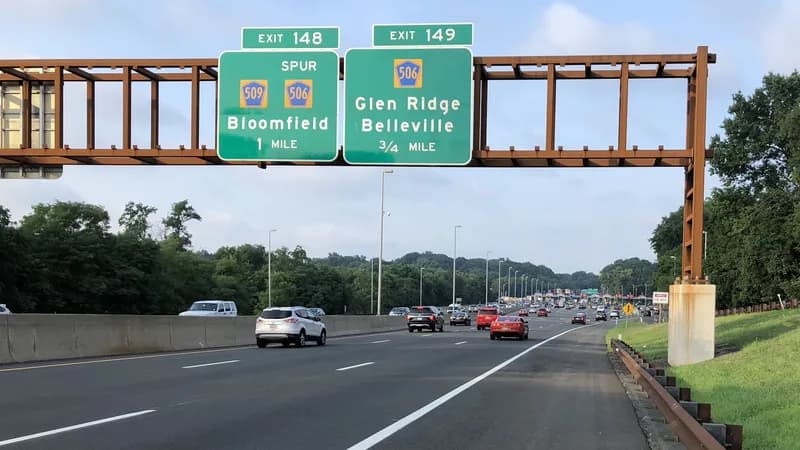
Photo credits: Garden State Parkway, Bloomfield by Famartin, CC BY-SA 4.0, cropped and resized.