

Cyclists hurt in New York City and on Long Island
NYC Bicycle Accident Attorneys
If a car or truck hit you while you were riding, that vehicle’s no-fault coverage generally pays your medical bills first. Your claim against the driver is a separate case with its own proof and deadlines.
Licatesi Law Group has represented injured people for more than 40 years.
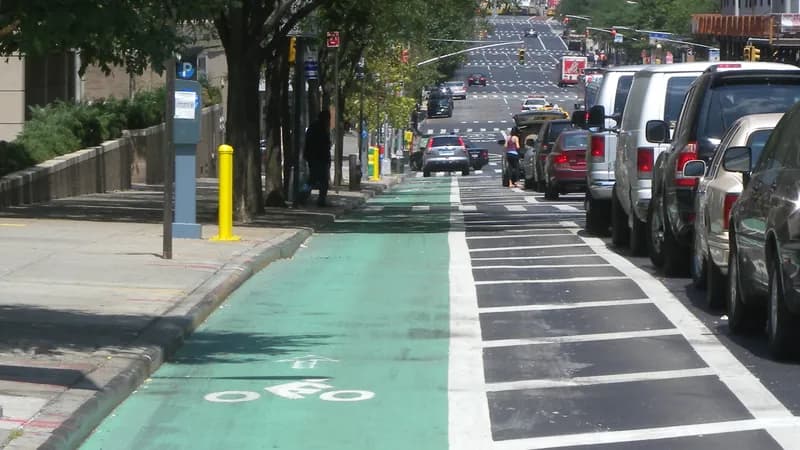
Start here
Who pays a cyclist? It depends on what hit you
New York’s no-fault system covers people hurt by a motor vehicle, including cyclists who were not riding in another vehicle. Crashes that do not involve a motor vehicle sit outside it.
- A car, truck, bus or taxi hit you
- Generally that vehicle’s no-fault coverage pays medical bills and part of lost earnings first, because you were not an occupant of another motor vehicle (Insurance Law 5103(a)(1); 11 NYCRR 65-3.12). The claim for pain and suffering is against the driver and owner.
- First deadline: Written no-fault notice within 30 days, late only with a written justification (11 NYCRR 65-1.1); a lawsuit against a private driver generally within three years.
- Someone opened a car door into you
- The person who opened it, and usually the vehicle’s coverage: no one may open a door on the traffic side until it is reasonably safe (VTL 1214). A taxi or ride-hail passenger can be the one who opened it.
- First deadline: As for any vehicle crash: notify the vehicle’s insurer within 30 days.
- The driver fled, or had no insurance
- The Motor Vehicle Accident Indemnification Corporation (MVAIC) can be a source of payment, and a policy in your household may matter (Insurance Law 5208).
- First deadline: Hit-and-run: police report within 24 hours and MVAIC filing within 90 days, if you qualify. Identified uninsured vehicle: 180 days. Limited exceptions need prompt review.
- Another cyclist, an e-bike rider or a pedestrian
- Outside no-fault: a pedal bicycle, and an e-bike that meets the legal definition, is not a “motor vehicle” (VTL 125). The claim is against the rider or owner and depends on their insurance or assets. See e-bike and e-scooter injuries.
- First deadline: Against a private rider or owner: no governmental notice of claim, and a lawsuit generally within three years. If a public body, or a rider working for an employer, is involved, that part of the claim is evaluated separately.
- A pothole, plate or broken pavement threw you
- Possibly whoever maintains that street or placed the hazard, but only if its responsibility, and any required notice, can be proved; a defect does not create automatic liability. In New York City, a defect claim generally needs prior written notice of that defect to the Department of Transportation (Admin Code 7-201).
- First deadline: City: notice of claim with the Comptroller within 90 days. County, town or village: 90-day notice of claim (GML 50-e). State road: Court of Claims rules.
Rows describe ordinary personal-injury claims. A death claim has separate notice, accrual and time-limit rules, and the exact defendant, exceptions and tolls must be checked in every case. Naming a public body, building or hospital explains which rule could apply; it is not a statement that anyone was at fault.
Fault
The traffic rules that decide fault on a bike
A broken rule is evidence, not automatic liability. We match video, signal timing, lane markings and the damage to each rule below.
- Due care
- Every driver must exercise due care to avoid colliding with any bicyclist (VTL 1146).
- Passing
- A driver overtaking a bicycle must pass to the left at a safe distance until safely clear (VTL 1122-a). The statute sets no fixed number of feet; what was safe is decided on the facts.
- Doors
- No door on the traffic side may be opened until it is reasonably safe and will not interfere with moving traffic (VTL 1214).
- Lane position
- A cyclist must use a usable bike lane where one is provided, or keep near the right curb, except when preparing a left turn or avoiding conditions that make it unsafe (VTL 1234). A blocked lane is a reason to leave it.
No helmet? Your damages are not reduced for that
Riders under 14 and anyone on a class 3 e-bike must wear a helmet, and localities may require more. Failing to comply “shall not … diminish or reduce the damages” in an injury or death case (VTL 1238(7)).
Limits on the claim
Serious injury and the 2026 fault rule
A cyclist entitled to no-fault benefits is a “covered person” (Insurance Law 5102(j)), so a pain-and-suffering claim against the driver can require a serious injury (5104(a)). A fracture is one of the listed categories; the jury decides fault first.
The statute does not say in so many words whether a cyclist’s suit is “subject to article fifty-one”, so the 2026 bar below may apply, and we check it in every case.
2026 changes apply by commencement date. They cover personal-injury actions under New York's no-fault law (Insurance Law article 51) commenced on or after May 26, 2026; what matters is when the lawsuit is commenced, not the accident date (DFS Circular Letter No. 3 (2026)). For those actions:
- the former 90/180 serious-injury category no longer applies;
- a claimant whose culpable conduct is greater than that of the defendant, or of the defendants combined, is barred from recovery; otherwise, including at an even 50/50 split, damages are reduced by the claimant's share (CPLR 1411);
- except in an action for death, non-economic damages are limited to $100,000 for an injured person who is at fault, is not barred under CPLR 1411, and was operating an uninsured vehicle they were responsible for insuring (unless the lapse in coverage was less than 30 days), was operating while impaired and was convicted of that offense, or was operating in the commission of, or immediate flight from, a felony and was convicted of it (Insurance Law 5104(d)).
If you were injured
These are the first deadlines for an ordinary negligence claim for a non-fatal personal injury. Property-damage and other claims can run on different clocks.
- The other driver or vehicle owner (a private party)
- No notice of claim. A personal-injury lawsuit generally must be started within three years (CPLR 214(5)).
- The City of New York itself (for example, a City-owned vehicle)
- A notice of claim with the Comptroller within 90 days of the incident; a lawsuit within one year and 90 days (NYC Comptroller, GML 50-e).
- The State of New York itself
- A negligence claim against the State goes to the Court of Claims: it must be filed and served on the Attorney General within 90 days after it accrues, or a notice of intention served within those 90 days and the claim then filed and served within two years (Court of Claims Act § 10(3)). A State worker or vehicle being involved does not by itself make the State liable.
If the crash caused a death
A wrongful death claim has its own clocks, which often start from the death or from the appointment of the estate's representative.
- Against a private driver or owner
- The estate's representative generally has two years after the death; if a criminal action is started against the same defendant for the same event, at least one year after that criminal action ends (EPTL 5-4.1).
- Against the City, a county, town or village
- Where a notice of claim is required, it is due within 90 days after the estate's representative is appointed (GML 50-e), and the lawsuit within two years after the death (GML 50-i).
- Against the State
- The claim must be filed and served within 90 days after the executor or administrator is appointed, or a notice of intention served in that time; in any event within two years after the death (Court of Claims Act § 10(2)).
- Against a transit or bridge authority
- Death claims follow separate notice and time-limit provisions, not the injury rules above. Identify the exact operator first.
A wrongful death action recovers the family’s pecuniary (financial) losses and medical and funeral costs (EPTL 5-4.3). Our guide to claims against a city or town explains notices of claim.
Firm-wide pedestrian results
Results for people hurt while walking
None of the firm’s published results describes a cyclist as the client. These are the firm’s published pedestrian results, quoted exactly as recorded; they are not cyclist outcomes, and one of them involves a pedestrian struck by a bicyclist. Over 40 years the firm has recovered more than $100 million for clients across New York and New Jersey.
Prior results do not guarantee a similar outcome. Every case depends on its own facts.
See the full verdicts and settlements archive$990,000
$990,000 Settlement at Jury Selection. Federal Court. Eastern District
Plaintiff was pedestrian struck by van resulting in multiple fractures requiring several surgeries.
$700,000
$700,000.00 Settlement at Jury Selection
Pedestrian accident sustaining right displaced zygoma fracture post trauma with significant displacement; right alveoli and palatal fracture with malocclusion; right orbital and ethmoid fractures with enophthalmos.
Read the case study$500,000
$500,000 RECOVERY
Plaintiff pedestrian struck by defendant bicyclist traveling wrong way on one-way street
$325,000
$325,000 Parking Lot Pedestrian Accident Settlement
We secured a $325,000 settlement on behalf of our client despite the defense arguing that his injuries were pre-existing. After being struck by a vehicle in a parking lot, our client sustained serious injuries that required laparoscopic surgery. Through diligent advocacy, we secured the compensation he deserved.
Questions
Bicycle accident questions
Call 911 and get medical care the same day. Photograph the vehicle, its plate, the lane and your injuries, collect witness names, and keep the bike, helmet and clothing. If the driver left, the MVAIC route generally requires a police report within 24 hours. Give written no-fault notice to the vehicle’s insurer within 30 days. Limited exceptions to both deadlines exist, but they need prompt review. Get advice before giving a recorded statement, while still meeting your own insurer’s timely notice and cooperation requirements.
Usually the driver, and sometimes the vehicle’s owner, if the driver failed to use the due care the law requires toward bicyclists, opened a door before it was reasonably safe, or passed too close. Cyclists have the same rights and duties as drivers, so the cyclist’s own conduct is compared too, and fault reduces or, in some 2026 cases, bars recovery. A city, county or town can be responsible for a road defect, but only under its own notice rules.
The law does not require one, and a minor claim may not need one. A lawyer helps when the injury is serious, fault is disputed, the driver fled, or a public body or several insurers are involved, because each has its own deadlines. Our consultation is free, and there is no fee unless there is a recovery.
If a motor vehicle hit you, no-fault benefits generally pay medical bills and part of lost earnings first, up to $50,000 of basic economic loss, regardless of fault. A claim against the driver can add economic loss beyond that and, if the injury meets New York’s serious-injury definition, pain and suffering. Damage to the bike is a separate property claim. We do not quote values before reviewing the records.
Most suits against a driver must be started within three years. For an ordinary injury claim against a city, county, town or village, a notice of claim is generally due within 90 days and a lawsuit within one year and 90 days. A State claim goes to the Court of Claims. A death action is generally due within two years. Hit-and-run claims through MVAIC generally need a police report within 24 hours and a filing within 90 days, if you qualify; limited exceptions need prompt review.
Head injuries including concussion, broken collarbones, wrists, arms, legs and hips, spinal injuries, road rash and scarring, and internal injuries. Some injuries, such as concussion or internal bleeding, are not obvious at first, so a same-day medical evaluation matters for your health and for the record of what the crash caused.
Yes. In New York, bicycle riders under 14, and anyone riding a class 3 e-bike, must wear a helmet, and some localities require more. But Vehicle and Traffic Law 1238(7) says that failing to comply is not contributory negligence or assumption of risk, does not bar a personal injury or wrongful death action, and does not diminish or reduce the damages recoverable. The defense cannot cut your damages simply because you rode without a helmet.
We start with the two questions that decide most cyclist claims: who pays first, and which deadline is already running. The firm has practiced injury law for more than 40 years and has recovered more than $100 million for clients firm-wide. We have four offices, in Uniondale, Brooklyn, Corona and Teaneck, New Jersey, and you can start by phone or video. The consultation is free, and there is no fee unless there is a recovery.
Talk to a New York bicycle accident lawyer
Tell us what hit you and where. We will tell you who pays first, which deadline is running and what to keep. If you are looking for the office closest to you, see bicycle accident lawyer near me.
What to bring
- Police report number
- Photos of the scene, bike, helmet and injuries
- The driver’s plate and insurance details
- Any no-fault or insurer letters
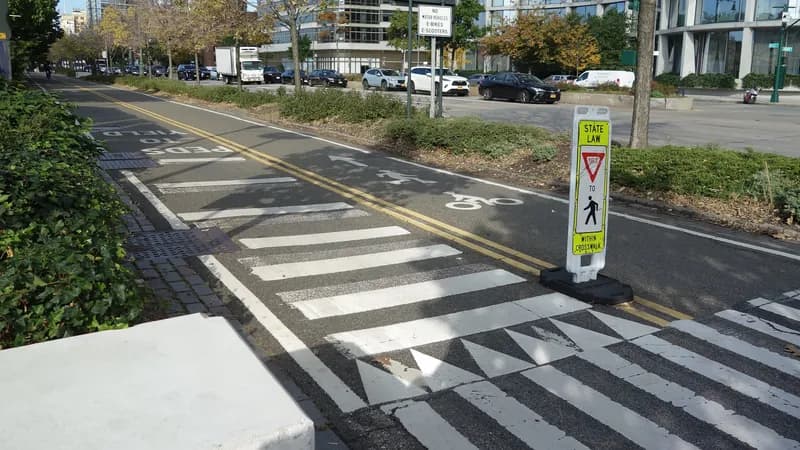
Photo credits: Hudson River Greenway by Tdorante10, CC BY-SA 4.0, cropped and resized.