

Sidewalk, step and object trips
Trip and Fall Accident Lawyers
A trip and fall claim turns on three things: the defect itself, who had to maintain that exact spot, and whether they knew or should have known about it.
We measure the defect and prove who had time to fix it. Over 40 years of experience. Free consultation, no fee unless there is a recovery.
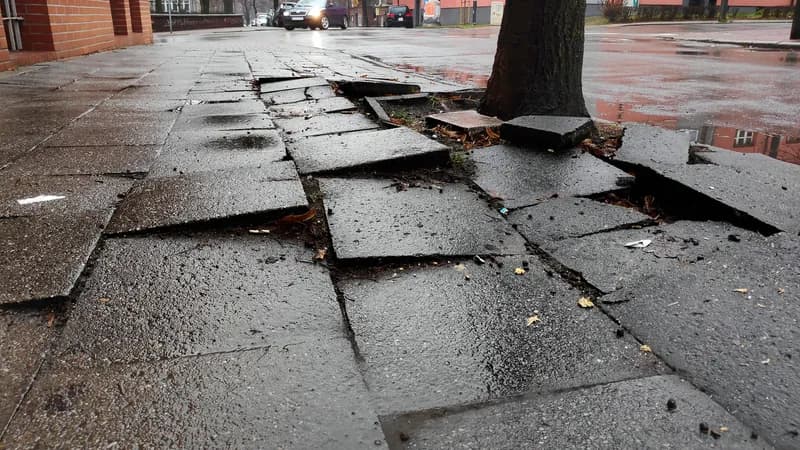
Trip, not slip
When something stops your foot
A trip happens when your foot catches an edge or an object and you pitch forward. The cause is usually a lasting defect or something left in the walkway, so the evidence is often still there days later, though owners do repair or patch it.
- Raised or sunken sidewalk flags
- Slabs lifted by tree roots
- Broken curbs, potholes and tree-pit edges
- Broken, uneven or loose steps and treads
- Torn carpet, curled mats and loose rugs
- Cords, boxes and merchandise in aisles
- Unmarked level changes and thresholds
- Dim stairwells, halls and parking areas
Slipped on water, ice or snow? See our slip and fall page. Elevator and escalator incidents have their own pages: elevator accidents and escalator accidents.
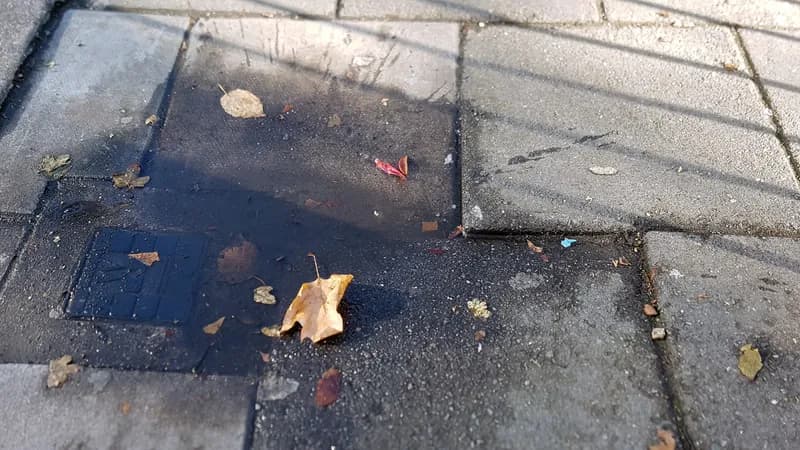
Photograph it with scale, if it is safe. Never step back into traffic or onto the hazard. A ruler or coin beside the raised edge, one close shot and one wide shot showing the address, before it is patched.
Is it big enough?
New York has no minimum defect size
Owners often call a defect “trivial.” New York's highest court has rejected any minimum height or depth test; whether a defect is dangerous depends on the facts and is usually for a jury (Trincere v County of Suffolk).
Small defects can be actionable when their surroundings make them hard to see, hard to recognize as a hazard or hard to walk over safely (Hutchinson v Sheridan Hill House).
- Size
- Height of the raised edge, width and depth of a hole or crack.
- Shape
- A sharp lip catches a shoe more easily than a gradual slope.
- Visibility
- Same-color concrete, shadows, leaves or poor light can hide it.
- Location
- Crowded entrances, crosswalk corners and stair landings draw attention elsewhere.
- Conditions
- Rain, darkness or a crowd at the time of the fall.
- History
- Complaints, prior falls or repair requests about the same spot.
New York City sidewalks
Tripped on a city sidewalk? Follow the ownership
Who you claim against depends on what the sidewalk runs along. Two different notices are involved: prior written notice of the defect, which the City generally must have had before your fall where that rule applies, and a notice of claim, which you file afterward when a public body may be responsible.
1.The sidewalk runs along privately owned property that is not an exempt one- to three-family home: a store, office, apartment building or other building
The abutting owner must keep the sidewalk reasonably safe and is liable for injuries caused by failing to do so (Admin Code § 7-210). Against a private owner there is no notice of claim and the ordinary deadline applies; if a public body owns the building, its own notice rules apply.
2.It runs along a one-, two- or three-family home that is owner occupied in whole or in part and used exclusively for residential purposes
Section 7-210 does not shift liability to that owner, though a homeowner who created the defect or made a special use of the sidewalk may still be responsible; that needs case-specific review. The City is not liable just because it owns the sidewalk: it generally must have had prior written notice of the defect and 15 days to repair it (Admin Code § 7-201), unless an exception applies, such as the City having created the defect. A Comptroller notice of claim within 90 days also applies.
3.You tripped in a street, crosswalk or curb, or on a park road or path, that the City maintains
The City may be responsible depending on who controlled that exact spot. Section 7-201 covers streets (including curbs and crosswalks) and certain park roads and paths, so prior written notice is often required; whether it applies to your location, and whether an exception applies, needs review. The 90-day notice of claim also applies.
4.The fall happened outside New York City
Counties, towns and villages have their own procedures, and where the law requires a notice of claim it is due within 90 days (GML 50-e). Check early which public body, if any, maintained the spot.
Inside buildings and on private lots, the claim is usually against the owner, a tenant business or a managing agent, and sometimes a contractor whose work created the defect. Brooklyn-specific property types are covered on our Brooklyn slip and fall page.
Deadlines
The first deadline to check
Evidence disappears: the defect gets patched, video is overwritten and witnesses move on. Start early even when the lawsuit deadline is years away.
These are the usual first deadlines for an ordinary negligence claim for personal injury, generally counted from the day of the injury. Wrongful death and other special claims run on different clocks; for example, a death notice of claim against a public body generally runs from the appointment of the estate's representative.
- A private owner, landlord, store or other private business
- No notice of claim. A lawsuit generally must be started within three years of the injury (CPLR 214).
- The City of New York
- A notice of claim filed with the Comptroller within 90 days of the incident, through eClaim or in person or by mail (email is not accepted); then a 30-day wait and any hearing the City demands; suit within one year and 90 days (NYC Comptroller).
- A county, town, village or school district
- Where a notice of claim is required, it must be served within 90 days after the claim arises (GML 50-e), and suit generally started within one year and 90 days (GML 50-i).
- The State of New York
- In the Court of Claims: the claim must be filed and served on the Attorney General within 90 days after it accrues, or a notice of intention served within those 90 days and the claim then filed and served within two years after accrual (Court of Claims Act § 10(3)).
- A public authority, such as a transit or housing authority
- Authorities have their own notice and filing statutes. Identify the exact entity first; do not assume the three-year rule.
- The injured person is a child
- CPLR 208 can extend the time to sue, but notice deadlines still need attention.
If you were partly at fault. In a fall case your share of fault generally reduces the damages in proportion; it does not bar the claim (CPLR 1411). The 2026 change that can bar recovery applies to no-fault motor-vehicle injury actions, not to falls on property.
An owner may argue the hazard was open and obvious. New York courts treat that mainly as a question of your comparative fault, not as an automatic defense (Westbrook v WR Activities-Cabrera Markets).
Premises results
Results for people hurt by unsafe conditions
These are the firm's published premises liability results, including falls from a defective step and at a restaurant. The records do not state the county where each case arose.
Prior results do not guarantee a similar outcome. Every case depends on its own facts.
See the full verdicts and settlements archiveAppellate result
Michael Licatesi Wins Again in the Appellate Division
The plaintiff was injured after falling from a defective step at a commercial property. Our Expert Witness provided evidence that the step's slope did not meet regulatory standards, and was a construction defect that the property owner failed to maintain and secure.
Read the case study$175,000
$175,000 Settlement
49 year old fell at a bar with disputed liability resulting in a dismissed case which Michael Licatesi, Esq overturned at the appellate level resulting in a monetary recovery
$950,000
$950,000 RECOVERY
Co-defendant neighbor aware that spill would flow onto her and is outside warning pedestrians negligently fails to apply salt or otherwise address the dangerous condition
$4,000,000
$4,000,000 Jury Verdict — Overturned Dismissal on Appeal
$4,000,000 jury verdict secured after overturning a dismissed case on appeal and obtaining a 100% liability finding for the plaintiff who suffered spine surgery as a result of a fall.
$225,000
$225,000 Apartment Building Slip-and-Fall Settlement
The Licatesi Law Group secured a $225,000 settlement after our client slipped and fell in their apartment building.
$250,000
$250,000 Settlement — Fall at a Burger Restaurant
Our client was injured after falling due to a dangerous defect at a burger restaurant. We fought to hold the responsible parties accountable and secured a $250,000 settlement for our client.
Next
Related guides
- Premises liability: how control and notice decide unsafe-property claims.
- Slip and fall: wet floors, ice and New York snow law.
- Slip and fall attorney near me: choose an office or start by phone or video.
- Premises liability lawyer near me: other property injuries.
- Suing a city or municipality in New York.
- Brooklyn slip and fall claims in Kings County.
Questions
Trip and fall questions
In a trip, your foot is stopped by something: a raised sidewalk flag, a broken step, a curb, a cord or a box. In a slip, your foot loses traction on water, ice or a polished surface. Trip hazards are often lasting defects, so the questions are how big and how visible the defect was and who had to repair it. Slip hazards are often temporary, so timing and notice dominate.
Sometimes. In New York City the abutting private owner is usually responsible for the sidewalk. The City may be the defendant for a sidewalk next to a one-, two- or three-family home that is owner occupied in whole or in part and used exclusively for residential purposes, or for a City-maintained street, crosswalk or curb, generally only where it had prior written notice of the defect and 15 days to fix it. A 90-day notice of claim also applies.
Get medical care and tell the provider how you fell. Only if it is safe, without stepping back into traffic or onto the hazard, photograph the defect close up and from a distance, with something for scale such as a ruler or coin beside the raised edge, and note the address or nearest building. Keep your shoes, write down witness names and report the fall to the owner or manager if it happened on private property.
Against a private owner or business, generally three years. Against the City of New York, a notice of claim within 90 days and suit within one year and 90 days. Claims against the State go to the Court of Claims with a 90-day rule, and public authorities have their own statutes. Because the sidewalk owner and the City follow different rules, find out who owns the adjoining property early.
Generally that the defect made the area unsafe, that the defendant was responsible for that spot, that it created the defect or knew or should have known about it in time to repair it or warn you, and that the defect caused your fall. Where the City’s prior-written-notice rule applies, that notice is usually also required.
Usually yes. Your share of fault generally reduces the damages in proportion rather than barring the claim (CPLR 1411). If the owner says the defect was open and obvious, that is mainly treated as a question of your comparative fault rather than an automatic defense.
Medical expenses, lost earnings and earning capacity, out-of-pocket costs, and pain and suffering, including scarring and loss of enjoyment of life. What a case is worth depends on the injury, the medical proof and the strength of the proof about the defect and notice.
Because people usually fall forward, wrist, elbow and shoulder injuries from breaking the fall are common, along with facial and dental injuries, knee injuries, hip fractures and head injuries. Get examined promptly, even if the injury seems minor.
No, but there is no minimum size either. New York courts have rejected any fixed height or depth rule. A small defect can be actionable when its shape, appearance, location, lighting or surroundings make it hard to see or hard to walk over safely. Courts look at all the facts, including the time, place and circumstances of the fall.
Not before your injury and your claim are understood. A settlement usually means signing a release that ends the claim for good, even if you later need more treatment. Have any offer reviewed against your medical records and losses. The decision to settle is always yours.
Talk to a trip and fall lawyer
Send us the address, photos of the defect and anything you know about the building next to it. We will explain who may be responsible, whether a City notice applies and what to request before the spot is repaired. The consultation is free.
What to bring
- Exact location, with photos showing scale
- The shoes you were wearing
- Witness names and any incident report
- Medical records so far
Photo credits: Sidewalk damaged by tree roots by Marek Ślusarczyk (Tupungato), CC BY 3.0, cropped and resized; A trip hazard on Philip Lane by Acabashi, CC BY-SA 4.0, cropped and resized.