

Nassau and Suffolk · Uniondale main office
Long Island Pedestrian Accident Lawyer
The same State law protects you in Nassau and Suffolk. Where you were hit, which police agency responded, who may be responsible and where the parties live decide the report, the court and any public-body notice.
Our Uniondale office serves both counties. More than 40 years of injury practice.
Start here
Nassau or Suffolk? What changes
Long Island has no single claims office. Use this as a starting point; the responding agency, the parties and who may be responsible can change the answer.
- Police report
- Nassau County: Nassau County Police Department reports are online about 48 hours later for people involved and listed relatives (NCPD). Some villages have their own police.
- Suffolk County: Suffolk County Police Department crash reports are online after 7 to 10 business days, or in person at headquarters in Yaphank (SCPD). If another police department responded, ask it for the report.
- Copy from the State
- Nassau County: The DMV also sells crash reports, which can take weeks to reach its system (MV-198C).
- Suffolk County: Same DMV route for Suffolk crashes.
- Court, if venued there
- Nassau County: Supreme Court, Nassau County, in Mineola.
- Suffolk County: Supreme Court, Suffolk County.
- Designated adult trauma centers
- Nassau County: Nassau University Medical Center, North Shore University Hospital, NYU Langone Hospital–Long Island (Level I adult) and Mount Sinai South Nassau (Level II adult).
- Suffolk County: Good Samaritan Hospital Medical Center, South Shore University Hospital, Stony Brook University Medical Center (Level I adult) and NYU Langone Hospital–Suffolk (Level II adult).
- Public bodies
- Nassau County: Nassau County, its towns, its cities and villages: a 90-day notice of claim for an ordinary injury claim; applicable prior-written-notice requirements can cover certain defects, subject to statutory and judicial exceptions (Town Law 65-a).
- Suffolk County: Suffolk County, its towns and villages: the same 90-day notice of claim (GML 50-e) and the same kind of prior-written-notice requirements and exceptions.
Ordinary injury claims only. Villages, cities and the counties can also have their own written-notice laws, which the notice-of-claim statute keeps in force (GML 50-e(4)). Hit in Nassau? Our Nassau County pedestrian page sorts the public bodies there.
Both counties
One State law for crossing the road
- 1. Crosswalk without paint. It can exist at an intersection where the sidewalk lines extend across the road (VTL 110).
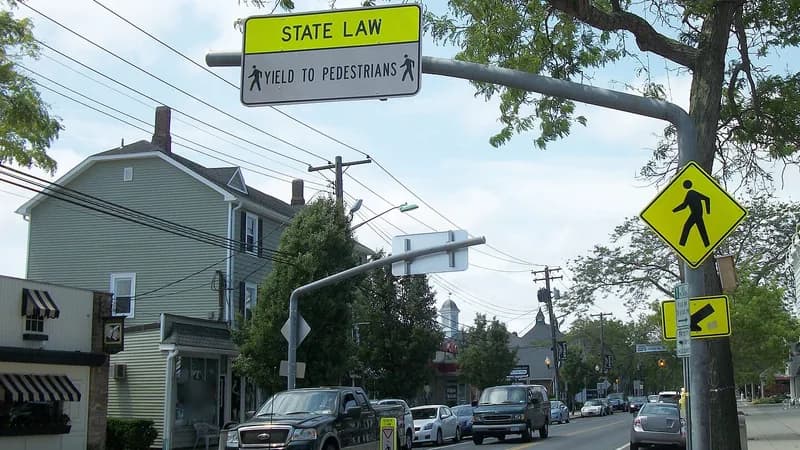
- 2. No working signal. Drivers yield to you in the crosswalk, as the yellow signs say, but you may not step out suddenly in front of a car too close to stop (VTL 1151).
- 3. Turning traffic. A driver turning on green yields to people lawfully in the crosswalk (VTL 1111).
- 4. Signals. WALK gives you the right of way; on a flashing or steady hand, do not start (VTL 1112).
- 5. Elsewhere. You must yield (VTL 1152), and drivers still owe due care (VTL 1146).
New York City’s own signal rules and its Comptroller process do not apply on Long Island.
Village main streets
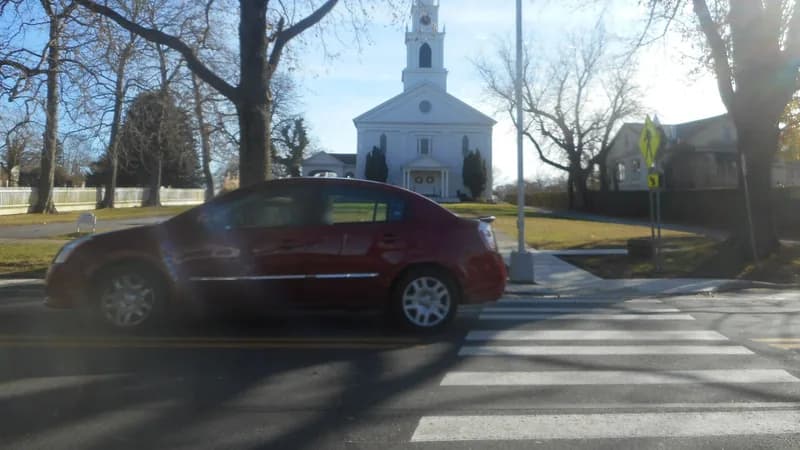
Some village main streets have crosswalks marked by paint and signs rather than signals, like this one. Whether the driver could see you in time is then the key question.
Who pays
Who pays, and how fault counts
Shared fault. Your own share of fault generally reduces damages in proportion; it does not end the claim (CPLR 1411).
For a personal-injury action subject to Insurance Law article 51 and commenced on or after May 26, 2026, recovery is barred if your fault is greater than the defendant's, or the defendants' combined (DFS Circular Letter No. 3 (2026)). That rule may apply to a pedestrian's claim against an insured driver, so a disputed crossing matters more than before.
No-fault first
For an eligible claim involving an insured motor vehicle, no-fault generally pays medical bills and part of lost earnings, up to $50,000 of basic economic loss, regardless of fault (Insurance Law 5103(a)(1), 5102(a)). Eligibility and which insurer handles the claim need review.
Then the driver and owner
Losses beyond no-fault, and pain and suffering if the injury meets New York's serious-injury definition, decided after fault (Insurance Law 5104(a)).
Written notice to the no-fault insurer is ordinarily due within 30 days (11 NYCRR 65-1.1). More detail: our pedestrian accident guide.
Firm-wide pedestrian results
Recorded pedestrian results
These are the firm's published pedestrian results, quoted exactly as recorded. The records do not say where the cases arose, so they are not presented as Long Island cases. Over 40 years, the firm has recovered more than $100 million for clients across New York and New Jersey.
Prior results do not guarantee a similar outcome. Every case depends on its own facts.
See the full verdicts and settlements archive$990,000
$990,000 Settlement at Jury Selection. Federal Court. Eastern District
Plaintiff was pedestrian struck by van resulting in multiple fractures requiring several surgeries.
$700,000
$700,000.00 Settlement at Jury Selection
Pedestrian accident sustaining right displaced zygoma fracture post trauma with significant displacement; right alveoli and palatal fracture with malocclusion; right orbital and ethmoid fractures with enophthalmos.
Read the case study$500,000
$500,000 RECOVERY
Plaintiff pedestrian struck by defendant bicyclist traveling wrong way on one-way street
$325,000
$325,000 Parking Lot Pedestrian Accident Settlement
We secured a $325,000 settlement on behalf of our client despite the defense arguing that his injuries were pre-existing. After being struck by a vehicle in a parking lot, our client sustained serious injuries that required laparoscopic surgery. Through diligent advocacy, we secured the compensation he deserved.
Deadlines
First deadlines on Long Island
Meet us at our Uniondale (main office), 423 RXR Plaza, East Tower, Uniondale, NY 11556; (516) 227-2662, or by phone or video. We have no Suffolk office; Suffolk clients meet us in Uniondale or by video.
Level I adult trauma centers: 3 in Nassau and 3 in Suffolk (NYS Department of Health).
- A private driver, owner or company
- No notice of claim. An injury lawsuit generally within three years (CPLR 214).
- A county, town, village or city
- For an ordinary injury claim: a notice of claim served within 90 days, a possible sworn examination, then suit within one year and 90 days (GML 50-e, 50-h, 50-i; County Law 52).
- The State itself
- For an ordinary injury claim, file the claim in the Court of Claims and serve it on the Attorney General within 90 days, unless a timely notice of intention, served on the Attorney General within those 90 days, extends the time to file (Court of Claims Act § 10).
- A public authority
- Its own notice statute. Identify the exact operator first; do not assume the three-year rule.
- A death
- A wrongful death action is generally due within two years of the death (EPTL 5-4.1). Against a county, town, village or city, its notice of claim runs 90 days from the representative's appointment (GML 50-e). The State, public authorities and the estate's claim for injuries before death follow different rules.
- A child was hurt
- The time to sue can be extended (CPLR 208), but notice deadlines still need attention.
Questions
Long Island Pedestrian Accident FAQs
Yes. Our main office at 423 RXR Plaza, East Tower, in Uniondale serves clients in Nassau and Suffolk counties, in person, by phone or by video. Venue depends on where the events happened and where the parties live. The police agency that responded has the report, and a notice of claim matters only if a public body may be responsible.
The New York State Department of Health lists these designated adult trauma centers. Nassau: Nassau University Medical Center, North Shore University Hospital, NYU Langone Hospital–Long Island (Level I adult) and Mount Sinai South Nassau (Level II adult). Suffolk: Good Samaritan Hospital Medical Center, South Shore University Hospital, Stony Brook University Medical Center (Level I adult) and NYU Langone Hospital–Suffolk (Level II adult). Emergency crews choose the hospital. Naming one does not suggest any affiliation with it or any fault by it.
We do not rank intersections without reliable data. For your claim, what matters is the crossing itself: whether there was a signal or a marked crosswalk, how long the WALK phase lasted, lighting, sight lines and what the driver was doing. Photograph the spot, note the nearest cross street and any cameras, and keep the police report number.
The State Vehicle and Traffic Law applies everywhere, but New York City’s own signal rules and its Comptroller claim process do not apply on Long Island. Here an ordinary injury claim against a responsible county, town, village or city usually needs a 90-day notice of claim, and applicable prior-written-notice laws can cover certain defects, subject to exceptions. Reports come from whichever police agency responded, and venue depends on the parties and events.
Possibly. At an intersection, a crosswalk can exist without paint where the sidewalk lines extend across the road. Crossing elsewhere, you must yield to vehicles, but drivers must still use due care. Your share of fault generally reduces damages; for a claim subject to the no-fault law commenced on or after May 26, 2026, recovery may be barred if your fault is greater than the defendants’ combined.
Call the police in the county where it happened right away; an MVAIC claim generally needs a police report within 24 hours and a filing within 90 days, though a late report can be excused if an earlier one was not reasonably possible. A car policy in your household may include uninsured-motorist coverage, depending on its terms. Note any partial plate, color or damage.
For an eligible claim involving an insured motor vehicle, no-fault generally pays medical bills and part of lost earnings, up to $50,000 of basic economic loss, regardless of fault. A claim against the driver and owner can add losses beyond that and, if the injury meets the serious-injury definition, pain and suffering. We do not quote values before reviewing the records.
For an eligible claim, the vehicle’s no-fault coverage generally applies first, and the driver and owner can be responsible for losses beyond it. Which policy covers a taxi or an app-dispatched car depends on the vehicle, its registration and whether a trip was under way, so we identify every insurer early.
We get the first steps right: the correct no-fault insurer, any 90-day notice to the right county, town, village or city, the police report from the right department, and requests for video before it is recorded over. Then we document how the injuries limit you, check every policy that may apply, and file in the proper county if the claim does not settle.
Against a private driver, generally three years. For an ordinary injury claim against a county, town, village or city, a notice of claim is generally due within 90 days and suit within one year and 90 days. A State claim must be filed in the Court of Claims and served on the Attorney General within 90 days, unless a timely notice of intention extends the filing time. Authorities and death claims follow separate rules. A child’s time to sue can be extended, but notices still apply.
Hit while walking on Long Island? Talk to us free
Tell us the town, the road and what hit you. We will tell you which police department has the report, the first deadline and who pays your medical bills. No fee unless there is a recovery.
What to bring
- The town and nearest cross street
- Police report or incident number
- Photos of the crossing and the vehicle
- Any insurer letters or claim numbers
Photo credits: Montauk Highway crosswalk, Sayville (plates and signs blurred) by DanTD, CC BY-SA 3.0, cropped and resized; Crosswalk at Bridgehampton Presbyterian Church (window blurred) by DanTD, CC BY-SA 4.0, cropped and resized.