

No-fault collections for health care providers
No-Fault Collections & Litigation
A provider's no-fault bill becomes collectible when it is overdue or denied, through arbitration or a court action.
What it can carry, and whether interest keeps running, depends on dates you control: when you billed, answered verification and filed.
The claim clock
Two different clocks: yours runs first, then the insurer's
The 45 days belong to the provider, for sending the bill. The insurer's 30 days generally start once it has proof of claim, including verification it properly asked for; an examination counts as received on the day it is held.
Step 1
Date of service
45 days to submit proof of claim, unless you give a clear and reasonable justification for the delay
Step 2
Insurer receives the application (NF-2)
10 business days to send the verification forms it needs; once completed verification forms, such as your bill, arrive, 15 business days to request more
Step 3
Written verification requested
120 days from the first request to supply what is in your possession or control, or a written reasonable justification; this rule does not cover EUO or examination requests
Step 4
Full proof received
30 days for the insurer to pay or deny, generally counted from receipt of the requested verification; undisputed parts must be paid
Step 5
Day 30 passes, unpaid
The benefits are overdue: 2% per month interest and a capped attorney’s fee
Step 6
Denial received
30 days to file for arbitration or sue, or interest pauses until you do; an interest rule, not a filing deadline
New York no-fault rules for health care providers as of October 12, 2026. This is general information, not advice on a particular claim; the dates on your own bills and letters decide which rule applies.
The money
What an overdue bill can carry
Potential recovery on an overdue bill can include the items below; this is not an exhaustive list. Interest is simple, not compounded, and it pauses if a denial sits 30 days without action.
- The bill
- The amount payable, generally at the fee-schedule rate. Fees above the permissible charges are not payable unless an insurer or arbitrator finds unusual procedures or unique circumstances justify them; that affects those fees, not the rest of the bill (Insurance Law 5108(a), 65-3.8(g)).
- Interest
- 2% per month, pro rata on a 30-day month, counted from 30 days after proof of claim; paused after a denial if you take no action within 30 days (65-3.9, 65-4.5(s)).
- Filing fee
- The $40 arbitration fee, returned by the insurer if you prevail in whole or in part (65-4.2(b)(1)(iii)).
- Attorney’s fee
- Paid by the insurer: generally 20% of benefits plus interest, up to $1,360 per applicant per proceeding; policy-issue disputes have their own hourly limits; generally none where charges exceed the schedule (65-4.6).
- Generally not included
- Compound interest; fees above the permissible charges without a recognized exception; benefits beyond the policy’s limits. Other items, such as court costs in a lawsuit, depend on the forum.
MRI and diagnostic imaging facilities: imaging bills follow the same rules. A denial can rest on a peer review of medical necessity or on the fee schedule, so the referral, the report and the coding belong in the file.
Two routes
Arbitration or a court action
Arbitration is an option the insurer must offer, not a requirement; a provider may sue instead (Insurance Law 5106(b)).
AAA arbitration
- $40 filing fee; supporting documents generally go in with the request
- Conciliation first, then an arbitrator; small disputes can be decided on papers
- Award paid within 30 days of mailing unless a master arbitration request, due within 21 days, stays it; it need not be confirmed
- Details: no-fault arbitration
Court action
- Court rules govern pleadings, discovery and motions
- Interest and the insurer-paid fee apply under the same limits
- Ends in a judgment, enforced like any judgment
- Which court, and any filing deadline, depends on the claim; we review this with you
Who handles collections
Collection trials and arbitrations
Our firm represents numerous healthcare providers in the collection of no-fault claims through arbitration and civil litigation.
Managing No-Fault Attorney. Represents medical providers in the New York courts, before the American Arbitration Association and in NJ Forthright forums, including at insurers’ examinations under oath.
Senior trial attorney. Practice areas include no-fault collection trials, healthcare provider representation and insurance arbitrations.
Related: denied benefits for denial grounds, EUO representation when the insurer asks for an examination, healthcare providers for the claim file, and the health care litigation overview.
Questions
No-fault collections questions
Before the dates run. After a denial, filing for arbitration or suing within 30 days keeps interest running; after that it pauses until you act (11 NYCRR 65-3.9(c)). That is an interest rule, not a filing deadline. An overdue bill with no answer can go to arbitration without a denial if you made a demonstrable attempt to get payment (65-4.2(b)(1)(v)). Older receivables are worth reviewing as a group to see which bills, dates and defenses are involved before choosing a route.
The amount payable on each valid bill, generally at the fee-schedule rate; interest at 2% per month on overdue benefits, figured pro rata on a 30-day month and subject to the pause after a denial; the $40 filing fee if you prevail in arbitration; and an attorney’s fee paid by the insurer within the regulation’s caps. Benefits are subject to the policy’s limits; other items, such as court costs in a lawsuit, depend on the forum.
In arbitration the rules set the steps: conciliation up to 60 days; the insurer’s 30 days, plus 30 on request, to respond; the hearing; an award within 30 days; then payment within 30 days unless the insurer appeals to a master arbitrator. File within 90 days of the denial or overdue date and you can ask for a hearing within 45 days of transmittal. Court actions follow the court’s schedule. We do not quote totals; calendars vary.
When a valid claim was overdue or denied, the insurer pays the provider’s attorney’s fee on top of the benefits and interest, within the regulation’s limits: generally 20% of the benefits plus interest, up to $1,360 per applicant per arbitration or court proceeding (11 NYCRR 65-4.6(d)). No insurer-paid fee is due if the claim was not overdue or denied when filed, and generally none if charges exceeded the fee schedule (65-4.6(a), (h)). That fee may not cover all legal costs; your own arrangement with counsel is agreed separately.
Be selective by evidence, not by size alone. Check whether proof of claim was timely or justified, whether verification was answered, whether the assignment is in order, what ground the denial states, what the medical records show, and whether the charges match the fee schedule. A claim that holds up on those points is worth filing; one with a defect you cannot cure may not be. Bills from the same accident can be grouped.
The arbitration forum consolidates disputes that arise out of the same accident and share common issues of fact, unless that is impracticable (11 NYCRR 65-4.5(c)). Insurer-paid attorney’s fees are calculated per applicant per proceeding (65-4.6(d)), so how claims are grouped affects the fee. Interest pauses on a denied bill if you wait more than 30 days to file, so holding denials back to build a larger batch can cost interest.
No. If you do not request arbitration or start a lawsuit within 30 days after receiving a denial, interest stops accumulating on the disputed amount until you do (11 NYCRR 65-3.9(c)). This is an interest rule, not a deadline to sue or arbitrate. Once a dispute is filed, interest continues unless the provider unreasonably delays the proceeding (65-3.9(d)). The rate is 2% per month, figured pro rata on a 30-day month; the regulation does not provide for compounding.
Hand over the complete file at the start: the rules generally require all supporting documents with an arbitration request; later the applicant may add bills for ongoing benefits, and other papers only if the arbitrator asks for or approves them (11 NYCRR 65-4.2(b)(3)). Keep answering any open verification. Tell us about any payment or offer you receive. Do not ask the patient for more than the authorized charges (Insurance Law 5108(c)).
The no-fault rules provide interest on overdue benefits and an insurer-paid attorney’s fee within set limits; the regulations discussed here do not describe penalties or punitive damages, and this page does not describe any separate bad-faith claim. If an insurer’s conduct seems to go beyond an ordinary payment dispute, tell us the facts and we will tell you whether any other remedy is worth considering.
Compare the offer with what the file can prove: the bill, interest, the filing-fee refund and the capped attorney’s fee, weighed against the strength of the insurer’s defense. Before the case goes to an arbitrator, the insurer may make a written offer; if you reject it, the arbitrator is not told about it (11 NYCRR 65-4.2(b)(4)). An insurer may not require you to waive interest as a condition of settlement (65-3.9(b)).
Sources: Insurance Law 5106, 5108; 11 NYCRR 65-1.1, 65-3.5, 65-3.8, 65-3.9, 65-4.2, 65-4.5, 65-4.6; DFS no-fault arbitration.
Send us your aged no-fault receivables
A list with dates is enough to start. We will sort the bills by where each stands, flag denials near the 30-day mark, and recommend a route. The consultation is free.
What to bring
- Unpaid bills with dates of service and mailing
- Denial forms with the dates received
- Verification requests and your replies
- Assignments for the patients involved
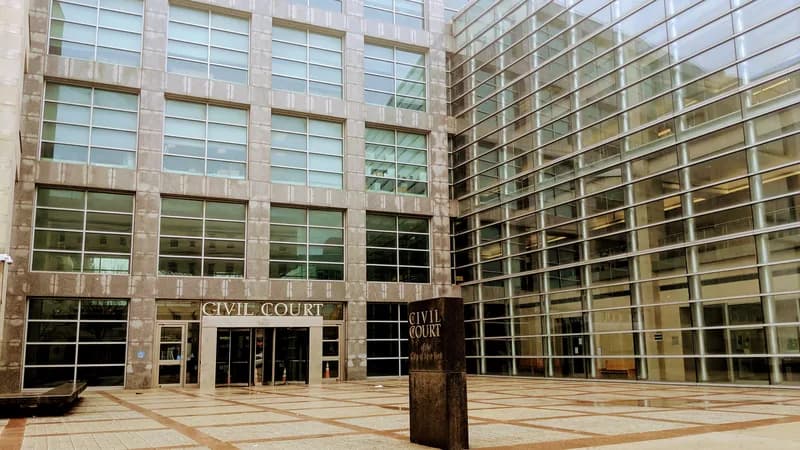
Photo credits: Queens Civil Court by CaptJayRuffins, CC BY-SA 4.0, cropped and resized; Courthouses on Sutphin Boulevard by CaptJayRuffins, CC BY-SA 4.0, cropped and resized.