Truck Accident Lawyer Near Me
Immediate response to preserve critical evidence. 40+ years of experience with 18-wheeler and commercial vehicle crashes. Free consultation 24/7.

Commercial vehicle evidence
We Preserve Trucking Evidence Before It Leaves the Roadway
Truck cases move fast because the carrier, insurer, maintenance vendor, and cargo company may all control different pieces of the record. The first job is to preserve the data and documents before the truck is repaired, reassigned, or cleared from service.
Data and logs
ELD records, dashcam files, dispatch notes, inspection reports, and maintenance history can shape the liability theory.
Multiple defendants
We look beyond the driver to the carrier, broker, owner, repair vendor, loader, and others who may have contributed to the crash.
Truck Accident Lawyers Near You - Immediate Response
Uniondale Office (Main)
543 Broad Hollow Road, Suite 2, Melville, NY 11747
Nassau County, Long Island
(516) 227-2662New Jersey Office
1325 Livingston Avenue, North Brunswick, NJ 08902
Middlesex County, NJ
(516) 227-2662Why a Local Truck Accident Lawyer Matters
When you search for "truck accident lawyer near me," proximity is critical for several reasons. First, a local attorney can respond immediately to the accident scene, interview witnesses while memories are fresh, and photograph evidence before it's removed. Second, local lawyers know the dangerous trucking routes in your area - the Cross Bronx Expressway, Brooklyn-Queens Expressway, Long Island Expressway, New Jersey Turnpike, and other high-traffic corridors where truck accidents frequently occur.
Third, local attorneys have relationships with area hospitals, medical experts, and accident reconstructionists who can provide immediate assistance. Finally, local lawyers understand New York and New Jersey trucking regulations, know the local courts and judges, and can meet with you face-to-face to discuss your case without travel hassles.
Licatesi Law Group has served the region for over 40 years with strategically located offices for immediate response to truck accidents throughout NYC, Long Island, and New Jersey.
Types of Commercial Vehicle Accidents We Handle
Federal Trucking Regulations We Use to Prove Your Case
Hours of Service Violations
Federal law limits driving time to prevent fatigue. We obtain ELD data proving violations.
Vehicle Maintenance Requirements
Mandatory inspections and repairs. We prove deferred maintenance caused the accident.
Driver Qualification Standards
CDL requirements, medical certifications, training. We prove negligent hiring.
Cargo Securement Rules
Weight limits and loading standards. We prove improper loading caused rollovers.
Truck Accident Statistics in New York & New Jersey
5,000+
Annual truck accidents in NYC metro area and NJ (NYPD, NJDOT, FMCSA data)
80,000 lbs
Fully-loaded commercial truck weight vs. 4,000 lbs passenger car - 20× weight difference creates catastrophic injuries
300+ ft
Stopping distance for loaded truck at highway speeds (vs. 120 ft for cars) - drivers can't stop in time
13× Higher
Fatality rate in truck vs. car collisions - occupants of passenger vehicles bear the brunt of injuries
Major Trucking Corridors in Our Service Area
New York/New Jersey Turnpike System: I-95 corridor handles 15-20% of nation's freight traffic. NJ Turnpike (I-95 through NJ) sees 200,000+ vehicles daily including 25,000-30,000 trucks. George Washington Bridge (I-95) is world's busiest motor vehicle bridge with 100,000,000+ annual crossings including significant commercial traffic. Verrazano-Narrows Bridge connects Staten Island/Brooklyn for truck traffic. These heavily-trafficked routes create constant truck accident risks during rush hours, overnight freight delivery times, and in poor weather.
Long Island Expressway (I-495): Major east-west route through Queens and Nassau County with significant commercial traffic serving Long Island businesses, JFK Airport cargo operations, and Port of New York/New Jersey freight. Congestion creates rear-end truck accidents, lane-change collisions, and merge accidents particularly near Queens-Midtown Tunnel and Cross Island Parkway interchanges. LIE truck accidents often catastrophic due to high speeds (55 mph speed limit but traffic often moving 65-70 mph when clear).
Cross Bronx Expressway (I-95): Notorious for congestion and truck accidents. Connects NJ to New England, forcing all north-south freight traffic through the Bronx. 180,000+ daily vehicles including massive truck volume. Aging infrastructure, tight curves, narrow lanes designed for 1950s-era trucks (not modern 18-wheelers), and constant construction create extremely dangerous conditions. Truck accidents on Cross Bronx often involve multiple vehicles due to sudden stops and limited escape routes.
Other High-Risk Truck Routes: Brooklyn-Queens Expressway (I-278) with tight curves and aging infrastructure, Garden State Parkway in NJ (commercial vehicles over 7,000 lbs restricted but delivery trucks allowed), Route 1 and Route 9 in NJ (heavy commercial corridors), Southern State Parkway/Northern State Parkway on Long Island (truck restrictions but violations occur), Major Deegan Expressway (I-87) through the Bronx, FDR Drive and West Side Highway in Manhattan (delivery truck accidents common).
Why Truck Accidents Are More Dangerous Than Car Accidents:
Massive Size/Weight Disparity: 18-wheeler fully loaded at 80,000 lbs gross vehicle weight vs. Honda Accord at 3,500 lbs = 23× weight difference. Physics dictates the heavier vehicle suffers minimal damage while occupants of lighter vehicle absorb massive force. This is why truck accidents routinely result in catastrophic injuries (brain damage, paralysis, amputations, death) even when truck driver walks away uninjured. Same collision at 60 mph: car crumples like tin can, truck barely damaged.
Stopping Distance Physics: At 65 mph, a passenger car may need about 120-140 feet to stop. A fully loaded 80,000 lb truck can need 300-400+ feet, meaning truck drivers cannot stop in emergencies that smaller vehicles can handle.
When traffic suddenly slows on I-95 or the LIE, a truck can rear-end stopped vehicles at high speed, causing catastrophic rear-end collisions, underride accidents, and multi-vehicle pileups.
Blind Spots (No-Zones): Commercial trucks have massive blind spots: 20 feet directly in front of cab (truck driver cannot see cars directly ahead), 30 feet directly behind trailer (no rear visibility), two lanes to right side (passenger side blind spot extends across multiple lanes), one lane to left side (driver side blind spot).
Passenger cars driving in these no-zones are invisible to truck drivers, leading to lane-change collisions, wide-turn accidents (truck turns right and crushes car on right side), and merge accidents. This is why 30-40% of truck accidents involve blind spot collisions.
Cargo Hazards: Unsecured cargo causes: rollover accidents (unbalanced loads shift during turns, causing truck to tip over onto adjacent vehicles), lost cargo accidents (improperly secured freight falls off truck onto roadway, causing multi-vehicle crashes), wide turn accidents (truck swings wide to make right turn, rear of trailer sweeps across lanes crushing vehicles), jackknife accidents (trailer swings perpendicular to cab during braking, blocking all lanes).
Federal cargo securement regulations (49 CFR Part 393) require proper loading but violations are common when trucking companies prioritize speed over safety.
Driver Fatigue Epidemic: FMCSA Hours of Service rules allow 11 hours driving per day, 70 hours in 8 days - but violations are rampant.
Electronic Logging Device (ELD) mandate (Dec 2017) was supposed to eliminate logbook falsification, but drivers still pressure dispatch for extended hours, drive fatigued to meet unrealistic delivery deadlines, use stimulants to stay awake, and manipulate ELD systems.
Fatigued truck drivers have reaction times equivalent to drunk drivers (0.08% BAC), causing preventable accidents on Cross Bronx, NJ Turnpike, LIE during overnight freight delivery times (10 PM - 6 AM when most truck traffic occurs).
Common Causes of Truck Accidents - Federal Violations We Prove
Hours of Service Violations (Driver Fatigue)
Leading cause of truck accidents nationwide
- FMCSA Hours of Service Rules: 49 CFR Part 395 limits driving time: 11 hours maximum driving after 10 consecutive hours off duty, 14-hour work window (on-duty time including loading/unloading), 60/70-hour limit over 7/8 consecutive days, mandatory 30-minute break after 8 hours driving. Violations create strict liability - if driver exceeded hours and caused accident, trucking company is liable regardless of other factors.
- Electronic Logging Device (ELD) Data: We immediately obtain ELD data (mandatory since Dec 2017) showing exact driving hours, rest breaks, on-duty time. ELDs record automatically and cannot be easily falsified like old paper logbooks. We've proven cases where drivers exceeded 11-hour limit by 2-3 hours driving overnight on I-95 or Cross Bronx, causing fatigue-related crashes. ELD data may be overwritten after 6 months - we send spoliation letters within 24-48 hours preserving evidence.
- Pressure from Trucking Companies: Dispatch pressures drivers to meet unrealistic delivery deadlines, pay per mile (not per hour) incentivizing speeding and skipping rest breaks, threaten termination if loads delivered late, create culture prioritizing profits over safety. We obtain dispatch communications, text messages, and company policies proving systematic pressure to violate Hours of Service. This establishes trucking company negligence beyond just driver fault.
- Fatigued Driving = Impaired Driving: Studies show 18+ hours awake (common for truck drivers violating HOS) produces reaction times equivalent to 0.08% BAC (legally drunk). Microsleep episodes (3-5 second lapses where driver's eyes close) at 65 mph = traveling 475 feet completely unconscious. This is how rear-end truck accidents happen on congested LIE, Cross Bronx, NJ Turnpike - driver simply doesn't react in time.
Vehicle Maintenance Failures
Brake failures, tire blowouts, steering problems
- Federal Maintenance Requirements: 49 CFR Part 396 requires: annual inspections, 90-day inspections for critical components (brakes, steering, tires, coupling), pre-trip and post-trip Driver Vehicle Inspection Reports (DVIRs), immediate repairs for critical defects. Trucking companies routinely defer maintenance to save costs, allowing trucks with defective brakes, bald tires, faulty steering to operate on I-95, LIE, Cross Bronx putting public at risk.
- Brake Failure Accidents: Commercial truck braking systems (air brakes) require regular inspection and maintenance. Brake fade (overheating from excessive use on downhill grades or congested traffic), air leaks, worn brake pads, improper adjustment cause brake failures. Runaway truck accidents on highways, rear-end collisions when truck cannot stop, jackknife accidents when brakes lock unevenly. We obtain maintenance records, DVIR reports proving trucking company knew about brake defects but allowed operation anyway.
- Tire Blowout Accidents: Truck tires carry enormous loads (4,000-5,000 lbs per tire). Underinflated tires, worn tread (federal minimum 4/32" for steer tires, 2/32" for other tires - but companies run tires until completely bald), overloaded trucks, road hazards (potholes, debris on NJ Turnpike, LIE) cause blowouts. Blowout at highway speed causes: loss of control (truck swerves into adjacent lanes), rollover (if steer tire blows out), tire debris flying into traffic causing windshield strikes and multi-vehicle accidents.
- How We Prove Maintenance Negligence: Obtain complete maintenance records for subject truck (often reveal pattern of deferred maintenance), inspection reports showing violations, work orders showing repairs not completed, testimony from trucking company mechanics describing pressure to pass defective trucks, Federal Motor Carrier Safety Administration (FMCSA) inspection database showing prior violations and out-of-service orders, physical inspection of truck (if preserved) showing defective components, black box data showing mechanical warnings ignored by driver.
Improper Loading & Cargo Securement
Rollovers, lost loads, wide-turn accidents
- Federal Cargo Securement Rules: 49 CFR Part 393 requires cargo secured to prevent shifting, specific tie-down requirements based on cargo type and weight, weight distribution to prevent rollovers, compliance with bridge law and axle weight limits (80,000 lbs gross vehicle weight maximum, 34,000 lbs tandem axle maximum, 12,000 lbs steer axle maximum). Violations create strict liability - if improper loading caused accident, cargo loading company and trucking company are both liable.
- Rollover Accidents from Unbalanced Loads: High center of gravity in trucks makes them prone to rollovers (especially on curved ramps, highway interchanges like Cross Bronx/I-95 junction, sudden lane changes). Unbalanced cargo (weight concentrated on one side or too high) exacerbates rollover risk. We've handled rollover cases on LIE where lumber truck tipped over during lane change crushing 3 passenger vehicles, tanker truck rolled on NJ Turnpike ramp spilling hazardous materials. Obtain loading manifests, weight tickets, photos of cargo after accident proving improper distribution.
- Lost Load Accidents: Improperly secured cargo falls onto roadway causing multi-vehicle crashes. Examples we've handled: steel coils falling off flatbed onto BQE killing motorcyclist, lumber spilling across all lanes of I-95 causing 5-car pileup, construction debris falling onto LIE during rush hour, pallets sliding off truck bed on Cross Bronx. Third parties (loading company, shipper) often liable in addition to trucking company and driver. Cargo securement violations are per se negligence.
- Overweight Truck Accidents: Exceeding 80,000 lb limit increases stopping distance (already 300+ feet becomes 400+ feet), accelerates brake wear (increasing brake failure risk), damages road surface creating hazards for all drivers, increases rollover risk, violates bridge weight limits (unsafe operation over Verrazano, GW Bridge, Throgs Neck). We obtain weigh station records, truck scale tickets, axle weight distribution proving overweight operation. Overweight violations often indicate broader safety culture failures.
Negligent Hiring & Driver Qualification Failures
Unqualified, untrained, dangerous drivers
- Commercial Driver's License (CDL) Requirements: Federal law requires Class A CDL for combination vehicles over 26,001 lbs (18-wheelers, tractor-trailers), passing knowledge test on air brakes/combination vehicles/general knowledge, passing skills test (pre-trip inspection, basic controls, road test), medical certification (DOT physical exam every 2 years, some conditions require annual exams), background check and driving record review. We obtain driver qualification files proving trucking companies hired drivers with suspended licenses, failed drug tests, multiple DUI convictions, falsified applications.
- Training Failures: Trucking industry has severe driver shortage, leading to inadequate training (some companies provide only 1-2 weeks training before putting new drivers in 80,000 lb trucks on I-95, Cross Bronx, NJ Turnpike), failure to train on specific vehicle types (flatbed, tanker, hazmat require specialized training but companies skip it), no defensive driving instruction for NYC/NJ congested conditions, no training on ELD systems, inadequate backing training (backing accidents common at delivery locations). We prove training failures through driver testimony, training records, company manuals showing inadequate curricula.
- Drug & Alcohol Testing Violations: Federal regulations (49 CFR Part 382) require: pre-employment drug testing (before driver operates CMV), random drug/alcohol testing (50% of drivers for drugs, 10% for alcohol annually), post-accident testing (after fatal accident or accident requiring tow-away), reasonable suspicion testing, return-to-duty testing after violation. Trucking companies that skip testing, ignore positive results, or fail to maintain testing consortium put dangerous drivers on the road. We've handled cases where drivers tested positive for methamphetamine, cocaine, marijuana but trucking company allowed continued operation.
- Prior Violations & Crash History: Federal Motor Carrier Safety Administration (FMCSA) maintains database of all commercial drivers' violations, crashes, inspections (Clearinghouse system). Trucking companies required to check database before hiring. We've proven negligent hiring cases where drivers had: 5+ prior crashes, multiple Hours of Service violations, DUI convictions, reckless driving tickets - yet trucking company hired them anyway because of driver shortage. Prior crashes/violations prove foreseeability of future accidents.
Catastrophic Injuries from Truck Accidents
The massive size and weight disparity between commercial trucks (80,000 lbs) and passenger vehicles (3,000-4,000 lbs) means truck accidents routinely cause catastrophic, life-altering injuries. Even "minor" truck accidents often result in injuries that would be considered severe in car-vs-car collisions.
Occupants of passenger vehicles absorb the enormous kinetic energy, leading to traumatic brain injuries, spinal cord damage, amputations, severe burns, and wrongful death at disproportionate rates. Insurance policies reflect this reality - trucks carry $750K-$5M+ coverage specifically because catastrophic injuries are expected outcomes.
Traumatic Brain Injuries (TBI) - Truck Accident Epidemic
Why TBI is common in truck accidents: Head strikes (windshield, A-pillar, dashboard, headrest during violent rear-end collisions from trucks hitting stopped traffic at 40-60 mph), brain acceleration/deceleration injuries (whiplash causing brain to strike skull even without direct head impact), rollover accidents (vehicle flipping multiple times after truck collision, occupants sustaining repeated head trauma), underride accidents (car goes under truck trailer, roof shears off causing direct head trauma).
Long-term consequences: Mild TBI (concussion, post-concussion syndrome lasting months to years, cognitive difficulties, inability to return to professional work, chronic headaches, mood changes) typically $200K-$800K settlements. Moderate TBI (loss of consciousness, memory impairment, personality changes, inability to work in cognitively demanding jobs, ongoing therapy) typically $800K-$3M.
Severe TBI (coma, permanent cognitive disability, 24/7 care needs, inability to live independently, vegetative state) typically $5M-$20M+ given lifetime care costs at NYC metro rates ($150K-$400K annually for attendant care, cognitive therapy, medical monitoring). We retain neuropsychologists, neurologists, life care planners to document full extent of damages.
Truck accident TBI case example: Client rear-ended by FedEx truck on LIE at 55 mph (client stopped in traffic, truck driver fatigued after 12-hour shift violated Hours of Service). Suffered severe TBI requiring craniotomy to relieve brain swelling. Permanent cognitive deficits, unable to return to work as accountant (previously earned $120K annually = $3M+ lost earning capacity over remaining work-life).
Settlement $8.5M (covered by FedEx's $5M policy plus umbrella coverage) for lifetime medical costs, lost earnings, pain and suffering. Trucking company's insurance policies make full compensation possible.
Spinal Cord Injuries & Paralysis
Mechanism of injury: Compression fractures (truck rear-ends car, compressing spine and fracturing vertebrae, fragments cutting spinal cord), hyperextension injuries (violent whiplash in rear-end truck collisions), rollover trauma (vehicle rolling multiple times after truck collision, occupants ejected or thrown around cabin), side-impact collisions (truck T-bones car at intersection, lateral force causing spinal fractures).
Settlement ranges by injury level: Complete quadriplegia (C1-C4 injury, ventilator-dependent, 24/7 skilled nursing care, total loss of independence, lifetime costs $15M-$30M in NYC metro area) settlements $10M-$25M. Incomplete quadriplegia (C5-C8 injury, some arm function preserved, wheelchair-bound, able to direct own care with assistance, lifetime costs $8M-$20M) settlements $8M-$20M.
Complete paraplegia (T1-L5 injury, lower body paralysis, wheelchair-bound but independent upper body, lifetime costs $5M-$12M) settlements $5M-$15M. Incomplete paraplegia (some lower body function, may walk with braces/assistive devices, lifetime costs $3M-$8M) settlements $3M-$10M.
Why truck accidents cause disproportionate spinal injuries: Highway-speed truck impacts can transfer enormous kinetic energy directly to the occupant's spine. Sudden rear-end collisions also give victims no time to brace.
Vehicle intrusion makes the danger worse when a truck overrides a car's bumper or crumple zones and directly impacts the passenger compartment.
Amputations & Crush Injuries
Common in truck accidents: Underride collisions (car goes under truck trailer, occupants' legs crushed or severed), rollover accidents (limbs protruding from windows, crushed when vehicle rolls), wide-turn accidents (truck turns right, rear of trailer sweeps across lanes crushing vehicles and occupants on right side), pin-and-crush accidents (car pinned between truck and barrier/guardrail, occupants trapped and crushed for extended periods before extrication).
Lifetime costs: Lower leg amputation ($800K-$2M settlements, prosthetic costs $50K-$80K replaced every 3-5 years for life, ongoing physical therapy, vocational rehabilitation if manual labor occupation, psychological counseling for adaptation).
Upper extremity amputation ($1M-$3M settlements, higher damages due to loss of hand function for activities of daily living, myoelectric prosthetics $80K-$150K, greater impact on employment particularly for skilled trades). Multiple amputations or amputations combined with other catastrophic injuries ($3M-$10M+ settlements). Young victims (20s-30s) receive highest settlements due to decades of prosthetic replacement costs and lost earning capacity.
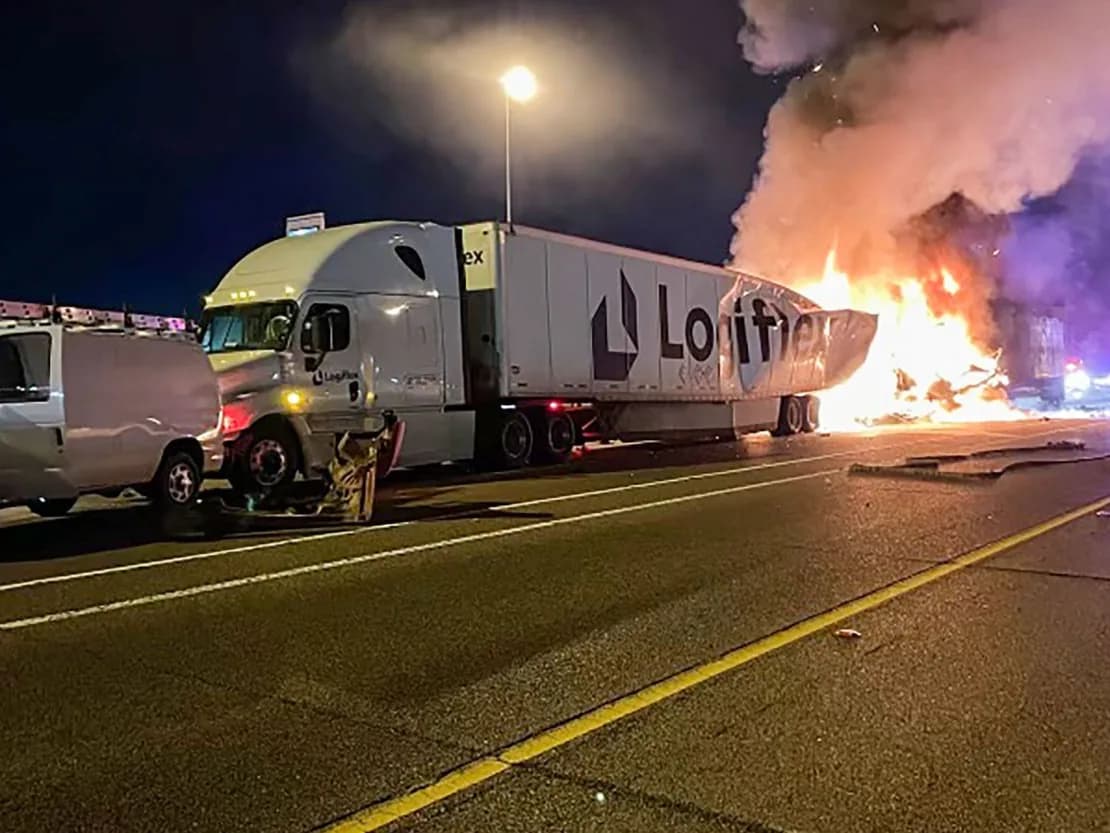
Severe Burns - Truck Fire & Explosion Accidents
Causes specific to truck accidents: Fuel tank ruptures (diesel fuel igniting after collision, creating fireball), tanker truck accidents (gasoline, chemical, or hazardous material tankers exploding or leaking flammable cargo), electrical fires (truck's electrical system shorting after collision, igniting fuel or cargo), post-collision fires (occupants trapped in vehicles unable to escape, suffering burn injuries before extrication), tire fires (friction from locked brakes causing tire fires spreading to fuel tanks).
Treatment & damages: Burn injuries requiring specialized care at regional burn centers (NY Presbyterian Weill Cornell Burn Center, Nassau University Medical Center Burn Unit, St. Barnabas Burn Center in NJ).
Third-degree burns covering 20-30%+ total body surface area (TBSA) require: initial hospitalization 2-6 months including medically-induced coma, debridement, skin grafts; 10-20+ reconstructive surgeries over 2-5 years; permanent scarring and disfigurement particularly devastating for facial burns; lifetime risk of skin cancer at graft sites requiring ongoing monitoring; psychological trauma requiring long-term therapy for PTSD, depression, body image issues.
Settlements typically $2M-$10M+ depending on TBSA percentage and location (facial burns have higher non-economic damages).
Wrongful Death - Fatal Truck Accidents
Disproportionate fatality rates: Occupants of passenger vehicles involved in truck collisions are far more likely to die than occupants of the truck.
An 80,000 lb truck striking a 4,000 lb car transfers massive force to the smaller vehicle. Underride crashes, fires, explosions, and vehicle override can turn otherwise survivable crashes into fatal ones.
Wrongful death damages (NY EPTL § 5-4.1): Fair and just compensation for distributees' (spouse, children, parents) loss of financial support (particularly significant when deceased was family breadwinner - 35-year-old NYC professional earning $150K annually = $6M-$8M lost financial support over family's lifetime), loss of services (child care, household maintenance, guidance and nurture for children), loss of consortium, conscious pain and suffering before death (if deceased survived minutes/hours before succumbing to injuries), funeral and burial expenses.
Settlements typically $2M-$5M for elderly victims with limited earning capacity, $5M-$15M+ for young parents or high-earners. Truck insurance policies ($1M-$5M+ standard, $10M-$25M for major carriers) make full compensation possible unlike car accidents limited to $25K-$100K policies.
Compensation in Truck Accident Cases - Higher Damages, Higher Insurance
Why Truck Accident Settlements Are 5-10× Higher Than Car Accidents
Massive Insurance Policies: Federal law (49 USC § 31139) requires minimum insurance for commercial trucks: $750,000 for trucks carrying general freight, $1,000,000 for trucks carrying oil/hazardous materials, $5,000,000 for certain hazardous materials.
Most major trucking companies carry $2M-$5M primary policies plus $10M-$25M umbrella/excess policies (UPS, FedEx, Amazon, major carriers often have $25M-$50M available coverage). Compare this to typical car insurance: NY minimum $25K/$50K (woefully inadequate), most drivers carry $100K-$300K maximum. This 10-50× insurance difference allows truck accident victims to recover full compensation for catastrophic injuries.
Multiple Liable Parties = Multiple Insurance Policies: Truck accidents often involve 3-5+ liable parties, each with separate insurance: (1) truck driver's personal liability coverage, (2) trucking company's commercial auto liability, and (3) trucking company's umbrella or excess coverage.
Additional coverage may come from the cargo loading company, truck or parts manufacturer, maintenance company, or leasing company when their conduct contributed to the crash.
We pursue all available policies, often resulting in $10M-$30M+ total available coverage for catastrophic injury cases.
Severity of Injuries Justifies Higher Damages: 80,000 lb truck vs. 4,000 lb car = catastrophic injuries (brain damage, paralysis, amputations, wrongful death) at rates 10× higher than car accidents.
When 30-year-old paralyzed victim requires $300K annually in attendant care for 50 years ($15M in care costs alone) plus $5M lost earning capacity plus $3M-$5M pain/suffering = $23M-$25M in total damages, those damages are fully compensable if sufficient insurance exists.
This is why federal law REQUIRES high insurance limits for trucks - catastrophic injuries are foreseeable outcomes. Unlike car accidents where damages may exceed insurance (causing uncompensated victims), truck accidents usually have adequate coverage.
Truck Accident Settlement Ranges (NYC/Long Island/NJ)
$100,000 - $500,000
Minor to Moderate Truck Accident Injuries
Fractures (arm, leg, ribs, collarbone) with full recovery in 6-12 months, herniated discs managed conservatively without surgery, soft tissue injuries with extended treatment course (whiplash, sprains, muscle tears requiring 6+ months physical therapy), lacerations requiring stitches or minor plastic surgery, concussions with full cognitive recovery.
Note: These injuries would settle for $25K-$100K in car accidents, but truck accident settlements 2-5× higher due to severity of impact and available insurance. Even "minor" truck accidents involve significant medical bills and treatment duration given forces involved.
$500,000 - $2,000,000
Serious Truck Accident Injuries with Permanency
Multiple fractures requiring surgery (femur, pelvis, multiple rib fractures, bilateral fractures), herniated discs requiring surgery (discectomy, fusion, laminectomy with permanent restrictions), shoulder injuries (rotator cuff tears, labral tears requiring arthroscopic repair), knee injuries (ACL/MCL/meniscus tears requiring reconstruction), permanent scarring (facial scars, visible scarring on arms/legs, burn scars), injuries preventing return to prior occupation (construction worker who can no longer do physical labor, driver who can no longer pass DOT physical, professional with cognitive deficits preventing complex work).
These cases involve $50K-$200K in medical expenses, significant lost wages, permanent pain/limitations, loss of earning capacity. Truck insurance policies ($1M-$5M) make full compensation achievable.
$2,000,000 - $10,000,000
Severe Truck Accident Injuries - Major Life Impact
Severe traumatic brain injuries may involve cognitive deficits, memory impairment, personality changes, and the inability to return to professional work without ongoing therapy or monitoring.
This range can also include incomplete spinal cord injuries, amputations, severe burns, multiple severe orthopedic or internal injuries, and loss of vision or hearing.
These cases involve: $200K-$1M+ in past medical expenses, $1M-$5M in future medical costs (life care plan projections), $1M-$5M in lost earning capacity (particularly NYC metro professionals earning $100K-$300K annually), $2M-$5M in non-economic damages (pain/suffering, loss of life enjoyment given permanent disability at young age).
Truck insurance policies sufficient to cover these damages in most cases.
$10,000,000 - $30,000,000+
Catastrophic Truck Accident Injuries
Complete quadriplegia cases may require ventilator support, 24/7 skilled nursing care, major home modifications, lost earning capacity calculations, and substantial pain-and-suffering damages.
Incomplete quadriplegia, complete paraplegia, and severe traumatic brain injury requiring 24/7 care can also support eight-figure lifetime damage claims.
Wrongful death claims involving young high-earners and cases with multiple catastrophic injuries can compound damages into the tens of millions.
Major trucking companies' umbrella policies ($10M-$50M) make these settlements achievable. We work with life care planners, economists, vocational experts to fully document lifetime damages and pursue maximum available coverage from all liable parties.
Legal Requirements & Immediate Action Steps
Contact Attorney Within 24-48 Hours: Unlike car accidents where you might have days/weeks, truck accident evidence disappears fast. ELD data may be overwritten after 6 months (but some systems overwrite sooner), black box data can be deleted in 30-90 days, dashcam footage erased within weeks, trucks repaired or destroyed eliminating physical evidence, driver logs and maintenance records "lost" or destroyed.
We send spoliation letters immediately (within 24 hours of retention) to trucking company, driver, cargo company, maintenance provider, leasing company commanding preservation of all evidence. Failure to preserve after receiving spoliation letter creates adverse inference at trial (jury instructed they can assume destroyed evidence was unfavorable to defendant).
NY/NJ Statute of Limitations: 3 years from date of truck accident in NY for personal injury claims, 2 years in NJ (shorter deadline - requires faster action). 2 years for wrongful death in both NY and NJ.
90 days to file Notice of Claim if government entity involved (NYC trucks, NJ Transit trucks, Port Authority trucks), then 1 year 90 days to file lawsuit. Missing these deadlines permanently bars your claim - no exceptions even for catastrophic injuries.
However, DON'T wait years to contact attorney - evidence preservation requires immediate action even though legal deadline is 2-3 years away.
No Upfront Costs - Contingency Fee Only: We handle all truck accident cases on contingency basis. You pay ZERO attorney fees unless we recover money for you.
We advance all litigation costs: accident reconstructionist fees ($10K-$30K), trucking industry expert witness fees ($15K-$50K), ELD/black box data extraction and analysis ($5K-$15K), medical expert fees ($10K-$40K for life care planners, orthopedic surgeons, neurologists), economist fees ($10K-$25K for lost earning capacity calculations), court filing fees, deposition costs, medical record fees, investigation costs.
Total case costs for complex truck accident litigation: $50K-$150K+ which we advance. If we don't win, you owe us nothing - we absorb all costs. This makes experienced truck accident representation accessible to everyone. Call (516) 227-2662 now for immediate free consultation.
Frequently Asked Questions
Don't Let Evidence Disappear - Call a Truck Accident Lawyer Now
24-hour response. Free consultation. No fees unless we win. We'll preserve evidence before it's lost.