
Motorcycle Accident Lawyer Near Me
Fighting rider bias for 40+ years. We understand motorcycle accidents and hold negligent drivers accountable. Free consultation.
Fighting "I Didn't See the Motorcycle" Excuses
Drivers who cause motorcycle accidents almost always claim they "didn't see" you. This is NOT a valid defense. Drivers must look for ALL vehicles before turning or changing lanes. We prove negligence even when drivers claim they didn't see you.
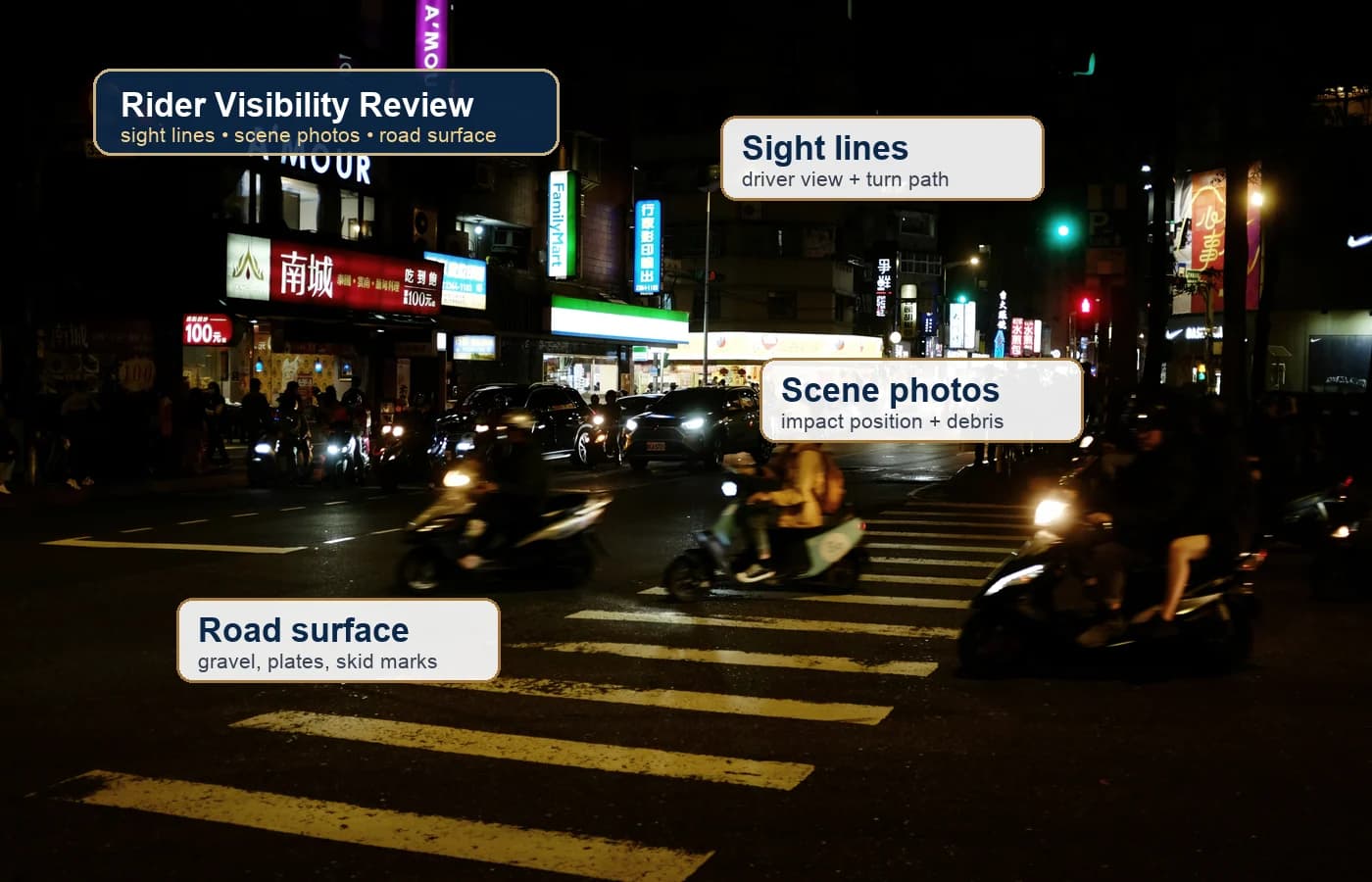
Rider Visibility Review
We Test the Driver's “Didn't See It” Story Against the Physical Record
Motorcycle crashes often turn on visibility, sight lines, and the seconds before impact. We move quickly to preserve scene photos, road surface details, vehicle positioning, and statements before the insurance narrative reduces the case to rider bias.
Visibility and turn path
We compare sight lines, lighting, lane position, and turning movement against the driver's version.
Roadway condition proof
Pavement plates, gravel, debris, and impact marks can matter more for a rider than for a car occupant.
NYC Motorcycle Accident Statistics
Motorcyclists face disproportionate risks on NYC roads. Despite representing less than 1% of vehicles, motorcyclists account for a significantly higher percentage of traffic fatalities and severe injuries.
Motorcycle Crashes Annually
NYC and surrounding areas
Motorcycle Fatalities
Annually in NYC (NYPD data)
Injury Rate
80% of motorcycle accidents result in injury or death
Driver Fault Rate
Caused by cars violating motorcyclist right-of-way
Important Fact: The most common cause of motorcycle accidents is drivers making left turns directly into the path of an oncoming motorcycle. Drivers fail to see motorcycles due to inattention, blind spots, or misjudging speed and distance. Per-mile traveled, motorcyclists are 28 times more likely to die in a crash than car occupants.
NYC's Most Dangerous Roads for Motorcyclists
Certain NYC roads and highways present unique hazards for motorcyclists including potholes, uneven pavement, metal plates, and aggressive drivers.
High-Risk Roadways
Belt Parkway (Brooklyn/Queens)
High speeds, aggressive lane changes, poor road conditions, frequent potholes
Brooklyn-Queens Expressway (BQE)
Narrow lanes, truck blind spots, uneven pavement, metal construction plates
Long Island Expressway (LIE/I-495)
High-speed traffic, sudden stops, construction zones, debris on roadway
FDR Drive (Manhattan)
Sharp curves, limited escape routes, pavement seams, high speeds
Grand Central Parkway (Queens)
Entrance/exit ramp accidents, lane merging collisions, high speeds
Hutchinson River Parkway (Bronx)
Curved roadway, aggressive drivers, limited shoulders, tree-lined hazards
Common Road Hazards for Motorcycles
Potholes & Uneven Pavement
NYC's deteriorating roads cause loss of control, tire blowouts, crashes. City may be liable.
Metal Construction Plates
Slippery when wet, uneven edges, cause motorcycles to slide or lose traction
Debris & Gravel in Roadway
Construction debris, gravel, oil spills cause tire slippage and loss of control
Railroad Tracks & Grates
Crossing at wrong angle causes front tire to catch, throwing rider
Painted Lane Markers (When Wet)
Slippery surface causes loss of traction, especially during braking or turns
Car Doors Opening (Dooring)
Drivers/passengers open doors into motorcycle path without checking
If you crashed due to a road defect, the city may be liable. We must file a Notice of Claim within 90 days against NYC.
Motorcycle Accident Injury Categories & Compensation
Motorcyclists lack the protection of a vehicle frame, airbags, and seatbelts. Even "minor" crashes often result in severe, life-altering injuries requiring extensive medical treatment and long-term care.
Road Rash & Skin Injuries
Typical Range: $25,000 - $500,000+
Common Injuries:
- Severe abrasions (road rash) - layers of skin scraped off
- Full-thickness burns requiring skin grafts
- Permanent scarring and disfigurement
- Infection risk (MRSA, sepsis)
- Nerve damage from deep abrasions
Treatment Required:
- Wound debridement (surgical cleaning)
- Skin graft surgery (multiple procedures)
- Infection treatment and IV antibiotics
- Scar revision surgery
- Physical therapy to restore mobility
Serious Injury Threshold: Permanent disfigurement meets NY serious injury threshold. Our firm recovered $325,000 for client with extensive road rash requiring 3 skin graft surgeries and permanent scarring.
Broken Bones & Fractures
Typical Range: $75,000 - $750,000+
Common Fractures:
- Clavicle (collarbone) - most common motorcycle fracture
- Femur (thigh bone) - severe pain, long recovery
- Tibia/fibula (leg) - often compound fractures
- Wrist, hand, finger fractures
- Pelvic fractures - life-threatening, internal bleeding
- Facial fractures (jaw, orbital, cheekbone)
Treatment & Recovery:
- Emergency surgery (ORIF - plates, screws, rods)
- 6-12 months physical therapy
- Possible second surgery to remove hardware
- Permanent hardware (titanium plates/screws)
- Risk of arthritis, chronic pain
Serious Injury Threshold: ANY fracture automatically meets threshold. Our firm recovered $485,000 for compound femur fracture requiring multiple surgeries and permanent disability.
Traumatic Brain Injuries
Typical Range: $750,000 - $10,000,000+
Even WITH a Helmet:
- Concussions and mild TBI
- Contusions (brain bruising)
- Diffuse axonal injury
- Skull fractures
- Intracranial bleeding/hematoma
Long-Term Effects:
- Memory loss, confusion, cognitive decline
- Personality changes, depression, anxiety
- Inability to work or perform daily tasks
- Increased risk of dementia, Alzheimer's
- Requires 24/7 care in severe cases
NY Helmet Law: All riders must wear DOT-approved helmets. Not wearing a helmet can reduce compensation for head injuries BUT doesn't bar recovery entirely. Our firm recovered $2.4M for moderate TBI requiring cognitive rehabilitation.
Spinal Cord Injuries & Paralysis
Typical Range: $2,000,000 - $15,000,000+
Types of Spinal Injuries:
- Herniated/ruptured discs (cervical/lumbar)
- Fractured vertebrae (compression fractures)
- Spinal cord damage
- Paraplegia (lower body paralysis)
- Quadriplegia (all limbs paralysis)
Lifetime Care Costs:
- Spinal fusion surgery ($150K-$300K)
- Wheelchair, home modifications ($100K-$250K)
- 24/7 attendant care ($50K-$150K annually)
- Paraplegia: $2.5M lifetime costs
- Quadriplegia: $5M+ lifetime costs
Serious Injury Threshold: Paralysis and spinal surgeries automatically meet threshold. Our firm recovered $3.8M for partial paralysis requiring lifetime wheelchair use and $1.9M for cervical fusion surgery.
Amputations & Limb Loss
Typical Range: $1,000,000 - $8,000,000+
Common Amputations:
- Lower leg amputation (below knee)
- Full leg amputation (above knee)
- Arm/hand amputations
- Finger/toe amputations
- Crush injuries requiring amputation
Costs & Challenges:
- Prosthetic limbs ($50K-$150K per limb)
- Replacement every 3-5 years (lifetime cost $500K-$2M)
- Physical therapy to learn prosthetic use
- Home/vehicle modifications for accessibility
- Psychological trauma and depression
Serious Injury Threshold: Dismemberment automatically meets threshold. Our firm recovered $4.2M for below-knee amputation requiring lifetime prosthetic replacements and loss of earning capacity.
Wrongful Death
Typical Range: $1,000,000 - $15,000,000+
Who Can File:
- Spouse/domestic partner
- Children (biological, adopted, stepchildren)
- Parents (if no spouse/children)
- Personal representative of estate
Recoverable Damages:
- Lost financial support (lifetime earnings projection)
- Loss of services, guidance, companionship
- Funeral and burial expenses
- Decedent's pain/suffering before death
- Punitive damages (if DUI or gross negligence)
Statute of Limitations: 2 years from date of death. Motorcyclist fatalities often involve drunk drivers, distracted drivers, or left-turn violations. Our firm recovered $5.8M for family of 32-year-old motorcyclist killed by drunk driver making illegal left turn.
Proving Negligence in Motorcycle Accident Cases
Insurance companies are biased against motorcyclists, often claiming riders are "reckless" or "at fault." We counter this bias with strong evidence and expert testimony.
Important Evidence We Preserve
Motorcycle Damage & Debris Pattern
Where bike landed, paint transfer, impact points prove how collision occurred and who had right-of-way
Helmet & Riding Gear Documentation
Photos of helmet damage prove impact severity; wearing proper gear counters "reckless rider" stereotype
Skid Marks & Road Evidence
Motorcycle skid marks are narrower than car tires; expert analysis shows braking, avoidance attempts
Surveillance Video/Dashcam Footage
Visual proof counters "I didn't see the motorcycle" excuse - shows bike was visible, driver didn't check
Driver Cell Phone Records
We subpoena phone records to prove distracted driving - texting, calls at time of crash
Police Report & Traffic Citations
Violations issued (failure to yield, unsafe lane change) create presumption of negligence
Expert Witnesses for Motorcycle Cases
Motorcycle Accident Reconstruction Experts
Specialized experts who RIDE motorcycles and understand bike physics, braking distances, lean angles, visibility issues. They testify about how the crash occurred and rebut driver excuses.
Biomechanical Engineers
Analyze impact forces and injury mechanism. Prove injuries are consistent with being struck by car, not from "reckless riding." Especially important for TBI, spinal cord injuries.
Orthopedic & Plastic Surgeons
Testify about fracture severity, road rash treatment, skin graft necessity, permanence of injuries. Explain why injuries required extensive surgery and long-term care.
Vocational Rehabilitation Experts
Calculate lost earning capacity when injuries prevent return to work. Important for catastrophic injuries like amputations, paralysis, TBI.
Life Care Planners
Project lifetime medical costs for permanent injuries. Calculate costs for future surgeries, prosthetic replacements, 24/7 care, home modifications.
Countering "Rider Bias" - Our Strategy
Insurance companies and juries often assume motorcyclists are "risk-takers" or "thrill-seekers." We fight this stereotype with facts and humanization:
Humanize the Rider
Present you as a responsible person - parent, employee, community member. Show you followed all traffic laws, wore proper gear, had valid motorcycle license.
Focus on Driver's Violation
Emphasize what the DRIVER did wrong - failed to yield, made illegal turn, changed lanes without checking, was texting. Make driver's negligence the focus, not rider behavior.
Use Credible Experts
Motorcycle accident reconstruction experts who ride explain that drivers have a duty to SEE motorcycles. "Didn't see you" is negligence, not an excuse.
Common Motorcycle Accident Scenarios
Frequently Asked Questions
Don't Let Insurance Companies Blame You
Free consultation. No fees unless we win. We fight rider bias and hold negligent drivers accountable.