

Find a bicycle accident lawyer near you
Bicycle Accident Lawyer Near Me
Near you means an office you can reach, or a phone or video meeting. We have four offices across New York City, Long Island and New Jersey.
If a car hit you, its no-fault coverage generally pays your medical bills first. Our bicycle accident guide explains why.
Where to meet us
Pick the office for where you ride
Choose the office nearest your home or the crash. A lawsuit is usually filed where a party lives or where the crash happened, so the office does not limit where we can bring your case.
Hit while walking instead? See pedestrian accident lawyer near me. On an e-bike or scooter? See e-bike and e-scooter injuries.
- Uniondale (main office)
Convenient for Nassau and Suffolk counties
423 RXR Plaza, East Tower, Uniondale, NY 11556(516) 227-2662
- Brooklyn
Convenient for Brooklyn and Staten Island
3857 Kings Highway, #1f, Brooklyn, NY 11234(718) 710-4880
- Corona (Queens)
Convenient for Queens and the Bronx
100-17 Northern Boulevard, Corona, NY 11368
- Teaneck (New Jersey)
Convenient for New Jersey
696 Palisade Avenue, Teaneck, NJ 07666
You can reach the firm at (516) 227-2662 whichever office you choose. Office details: locations.
The coverage and deadline guidance on this page is New York law. A crash in New Jersey follows New Jersey law; see our New Jersey injury guide.
Before you meet anyone
Your first 30 days after a bike crash
For an ordinary New York injury claim, these are the first steps and earliest deadlines. Some run from the crash; medical-bill proof runs from each treatment, and death claims follow separate rules.
- Day 1
- Call 911, get medical care and the police report number. If the driver fled, report it within 24 hours for the MVAIC route (Insurance Law 5208); limited exceptions need prompt review.
- Week 1
- Keep the bike, helmet and clothes as they are. Write down nearby cameras; private video can be overwritten. Get advice before giving a recorded statement, while still meeting your own insurer’s timely notice and cooperation requirements.
- Within 30 days
- Written notice to the no-fault insurer of the vehicle that hit you (11 NYCRR 65-1.1). Medical bills then follow within 45 days of each treatment.
- Within 90 days
- Ordinary injury claim against a city, county, town or village (its vehicle or its street): a notice of claim within 90 days (GML 50-e); in New York City it is filed with the Comptroller.
- Hit-and-run
- Hit-and-run: a police report within 24 hours and an MVAIC filing within 90 days, if you qualify (Insurance Law 5208). Limited exceptions exist, but they need prompt review.
- The State or an authority
- A claim against the State itself goes to the Court of Claims: filed with the court and served on the Attorney General within 90 days, or a notice of intention served in that time (Court of Claims Act § 10). Public authorities, such as transit operators, have their own notice rules.
A late no-fault notice is accepted only with written proof of a clear and reasonable justification. Do not count on it. Death claims, tolls and exceptions follow separate rules and must be checked case by case.
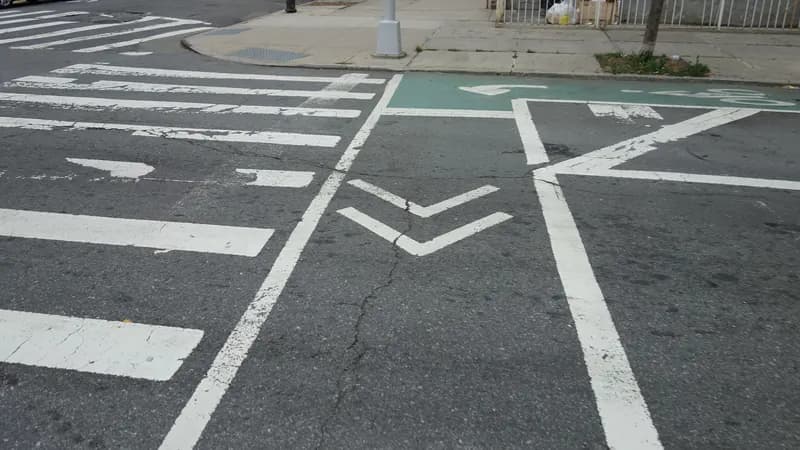
Our Corona office serves Queens and the Bronx. Brooklyn riders can also see our Brooklyn pedestrian accident page, and Nassau riders our Nassau County crash page.
Choosing a lawyer
Five questions to ask any bike-crash lawyer
A lawyer who handles cyclist claims should answer these at the first meeting. Here are the short answers under New York law.
Who pays my medical bills first?
If a motor vehicle hit you: generally that vehicle’s no-fault coverage, because you were not in another vehicle (Insurance Law 5103(a)(1)). A crash with another bike or a pothole sits outside no-fault.
Does my missing helmet matter?
It cannot reduce your damages (VTL 1238(7)).
Was I allowed to leave the bike lane?
Yes to turn left or avoid something unsafe, such as a blocked lane (VTL 1234).
Does the 2026 fault rule apply to me?
It may; a good answer explains why and when your case would be started.
How is the fee set?
Ours: free consultation, no fee unless there is a recovery, with the agreement explained in writing.
Questions
Finding a bicycle accident lawyer: questions
Start with the office you can reach, or with a call or video meeting if you are injured. Then ask the lawyer the questions on this page: who pays first, whether the helmet rule matters, which deadline is already running and how the fee works. Licatesi Law Group has offices in Uniondale, Brooklyn, Corona (Queens) and Teaneck, New Jersey, and more than 40 years of injury practice.
On the road you have the rights and duties of a driver. Drivers must use due care to avoid hitting you, pass at a safe distance and not open a door into traffic until it is safe. You must use a usable bike lane where one is provided, except to turn left or avoid an unsafe condition, ride with lights at night, and obey signals. Riders under 14 must wear a helmet.
If a motor vehicle hit you in New York, no-fault generally pays eligible medical bills and part of lost earnings first, up to $50,000 of basic economic loss. A claim against the driver can add losses beyond that and, if the injury meets New York’s serious-injury definition, pain and suffering. Bike damage is a separate property claim. We do not quote values before reviewing the records.
Then the evidence decides it: video, signal timing, lane markings, where the damage is on the bike and the vehicle, and witnesses. Your own fault is compared with the driver’s. It generally reduces damages rather than barring them. In a personal-injury action subject to Insurance Law article 51 that is commenced on or after May 26, 2026, a claimant whose fault is greater than that of the defendant, or of the defendants combined, recovers nothing; whether that rule reaches a cyclist’s case is checked case by case.
Not the way insurers often suggest. New York requires helmets for riders under 14 and for class 3 e-bike riders, but Vehicle and Traffic Law 1238(7) says that failing to comply does not bar the claim and does not diminish or reduce the damages. If you were wearing one, keep it: the damage shows where you were hit.
Call 911 and get medical care the same day. Photograph the vehicle, its plate, the lane and your injuries, and get witness names. Keep the bike, helmet and clothing. If the driver fled, report it to police within 24 hours, and send written notice to the vehicle’s no-fault insurer within 30 days; limited exceptions exist, but they need prompt review. Get advice before giving a recorded statement or posting about the crash, while still meeting your own insurer’s timely notice and cooperation requirements.
Often, yes. Vehicle and Traffic Law 1214 says no one may open a door on the side of moving traffic unless it is reasonably safe and will not interfere with traffic. The person who opened the door, whether a driver or a passenger, can be responsible, and the vehicle’s no-fault coverage generally pays your medical bills first. Fault is still decided on the facts.
We start with the who-pays and deadline questions at the first meeting. The firm has more than 40 years of injury practice and has recovered more than $100 million for clients firm-wide. You can meet us at one of four offices or by phone or video. The consultation is free, and there is no fee unless there is a recovery.
Hit while cycling? Start with a free call
Tell us where it happened and what hit you. We will name the first deadline, who pays first and what to keep. No fee unless there is a recovery.
What to bring
- Police report number
- Photos of the bike, helmet and scene
- The vehicle’s plate and insurer, if known
- Your health insurance card
Photo credits: 46th Avenue and 111th Street, Corona by Tdorante10, CC BY-SA 4.0, cropped and resized.